Florida’s humidity is a defining feature of life here — and one of the most consequential factors for any home’s exterior condition. Tallahassee sits at the northern edge of Florida’s subtropical climate zone, which means we experience the full intensity of Gulf Coast humidity without the constant coastal breeze that moderates conditions further south. Relative humidity regularly exceeds 70% from spring through fall, and even winter months see persistent moisture that most of the country doesn’t deal with. For your home’s exterior surfaces, this sustained humidity is the primary driver of the maintenance challenges that set Florida homes apart from homes in drier climates.
What High Humidity Does to Exterior Surfaces
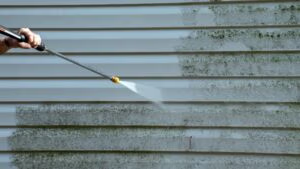
The most direct effect of sustained humidity is biological colonization. Algae, mold, mildew, and lichen require moisture to establish and grow — Florida’s climate provides that moisture with almost no interruption during the warmer months. Surfaces that stay damp for hours after rain (shaded siding, north-facing walls, areas under tree canopy) become colonized faster than surfaces that dry quickly in sun.
Gloeocapsa magma — the cyanobacteria responsible for the dark streaking on roofs — thrives in humid subtropical climates and can establish visible colonies on asphalt shingles within 12–18 months in Tallahassee conditions. Mildew on vinyl siding develops a visible haze within months on north-facing surfaces or areas under tree canopy. Pool cage aluminum frames and screen panels develop green biological growth year-round when humidity is sustained.
For painted surfaces, humidity accelerates paint failure in several ways. Moisture infiltrating the substrate behind the paint film causes hydrostatic pressure that pushes the film away from the surface — the mechanism behind paint bubbling and blistering that’s common on Florida homes. Mold and mildew growing between the paint film and the substrate break the adhesive bond, causing the paint to lose adhesion and peel. In Tallahassee’s climate, exterior paint applied over a surface not properly cleaned and dried often fails significantly faster than the manufacturer’s expected lifespan.
Wood components — fascia boards, soffits, window and door trim, deck boards, fencing — absorb moisture continuously in high-humidity conditions. Repeated wet-dry cycles accelerate the checking (surface cracking), warping, and fiber degradation that leads to rot. Wood components on Florida homes need more frequent inspection and maintenance than the same materials in drier climates.
The Tree Canopy Multiplier
Tallahassee’s urban tree canopy is one of the densest of any city in the country, and it amplifies the humidity effects on home exteriors significantly. Homes under mature oak, pine, or other large-canopy trees stay damp longer after rain because the canopy slows evaporation and blocks the sunlight that would otherwise dry surfaces quickly. Shaded surfaces in humid conditions are dramatically more susceptible to biological growth than the same surfaces in full sun.
The organic debris the canopy deposits — leaves, pine needles, pollen, small twigs, Spanish moss fragments — provides a nutrient layer on roofs, in gutters, and along siding that feeds biological growth. A home in Killearn Estates or Waverly Hills under dense oak canopy requires more frequent exterior maintenance than a comparable home in a less-canopied suburban subdivision in Crawfordville or Midway, simply because the canopy creates a microclimate that accelerates every moisture-related degradation process.
Protecting Against Humidity Damage: The Maintenance Response
The most direct response to Florida’s humidity-driven exterior challenges is regular cleaning and surface protection. Annual soft washing of house siding kills biological growth before it establishes deep enough to cause surface damage, and the residual biocide protection suppresses regrowth for 12–18 months. Roof soft washing every 2–3 years (annually on heavily shaded roofs) prevents the algae and moss growth that degrades roofing materials. Gutter cleaning twice per year prevents the overflow that saturates foundation soil and fascia.
Surface sealing is the other key protective measure. Sealed pavers, sealed concrete, and properly painted wood surfaces are dramatically more resistant to moisture infiltration and biological growth than unsealed surfaces. The sealer or paint film creates a barrier that slows moisture absorption, makes the surface less hospitable to algae adhesion, and makes cleaning easier when maintenance is needed. In Tallahassee’s climate, the ROI on regular sealing maintenance is higher than in most markets precisely because the damage from neglected sealing is more severe and faster-developing here.
Ventilation matters for enclosed spaces. Pool cages and screen enclosures that trap humid air accelerate biological growth on frame and screen surfaces. Ensuring screen panels are in good condition (providing airflow) and that there are no sections where debris accumulates and holds moisture extends the clean period between professional treatments.
What Humidity Damage Looks Like Before It Gets Serious
Early intervention is dramatically more effective than waiting for obvious damage. The early indicators to monitor on a Tallahassee home’s exterior: green or gray haze developing on north-facing siding (biological growth establishing), dark streaking beginning on roof slopes (algae), soft or discolored areas on wood fascia or trim (early rot), paint bubbling or micro-blistering on siding (moisture behind the film), and gutters with visible plant growth in them (debris accumulated past the point of simple cleaning).
None of these are emergencies at the early stage. All of them become significantly more expensive if allowed to progress for another season without intervention.
Professional Exterior Cleaning and Protection in Tallahassee
Around The Bend Pressure Washing provides comprehensive exterior cleaning services throughout Tallahassee and the surrounding region — house washing, roof soft washing, driveway and concrete cleaning, pool cage cleaning, gutter cleaning, and paver sealing. We understand the specific maintenance demands that Tallahassee’s climate creates and approach each job with that context. Serving Leon, Gadsden, Wakulla, and Jefferson counties including Killearn Estates, Betton Hills, Bradfordville, Crawfordville, Midway, Quincy, and Woodville. Call us at 850-888-2105.