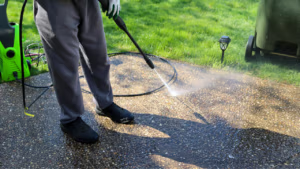
Driveways are the first thing visitors and potential buyers see when they approach a property. They’re also one of the surfaces that accumulates the most visible contamination fastest in Tallahassee’s climate — and one of the most neglected because people tend to walk past them rather than look down at them critically. By the time a driveway looks obviously bad, it’s been degrading for a while.
Here’s why regular driveway cleaning matters beyond aesthetics, and what makes Tallahassee’s specific conditions a reason to take it more seriously than a lot of maintenance guides suggest.
What’s Actually on Your Driveway
The contamination on a typical Tallahassee driveway is a combination of biological growth, mineral staining, vehicle deposits, and organic debris — and each type has a different impact on the concrete surface and requires a different approach to clean.
Biological growth is the dominant category. The algae, mold, and mildew that color concrete green, gray, and black in Florida’s climate aren’t just surface discoloration — they produce organic acids as byproducts of their metabolism that slowly attack the cement matrix in concrete. Over years of untreated growth, this biological acid exposure contributes to surface erosion, scaling, and pitting. In shaded areas of a Tallahassee driveway — under trees, along the north edge of the property — this growth can become significant within a single season.
Leon County’s red clay soil tracks onto driveways constantly, particularly where lawn edges meet the driveway surface and where vehicles pull in from clay or dirt adjacent areas. Clay staining appears as orange-red discoloration that penetrates into concrete pores and becomes increasingly difficult to remove the longer it sits. Early treatment with appropriate chemistry removes clay staining far more easily than staining that has been allowed to dry and cure into the concrete surface over multiple rain-and-dry cycles.
Vehicle fluid deposits — oil drips, power steering fluid, transmission fluid — are petroleum-based and absorb into concrete quickly. Fresh oil responds well to degreaser treatment and pressure washing. Oil that has been on the concrete for weeks or months penetrates below the surface layer and becomes permanently embedded. Prompt treatment is the most effective approach; waiting until the stain is extensive means you’re managing appearance rather than fully removing it.
Concrete Preservation: The Long-Term Case
Replacing a concrete driveway in Tallahassee costs $6–$12 per square foot installed, depending on thickness, reinforcement, and finishing. A standard two-car driveway (500–700 sq ft) represents $3,000–$8,400 in replacement cost. Regular cleaning that extends the serviceable life of the driveway by even a few years represents meaningful value.
The mechanisms by which neglected cleaning damages concrete over time: biological acids eroding surface cement, freeze-thaw damage accelerated by water infiltration into surface cracks (less of an issue in Tallahassee than further north, but temperature cycling still stresses concrete), and oil saturation weakening the surface layer in high-drip areas. Annual cleaning interrupts all three mechanisms before they cause cumulative damage.
Curb Appeal and Property Value
Real estate agents consistently identify driveway condition as one of the first things buyers notice about a property. A dark, stained driveway signals deferred maintenance even if the house itself is in excellent condition. In Tallahassee’s market — where homes in Killearn Estates, Southwood, and Betton Hills compete on presentation — exterior condition influences both selling price and time on market. Pre-listing pressure washing of the driveway, walkways, and exterior surfaces is one of the highest-ROI preparations a seller can make.
For homeowners not selling, regular driveway cleaning is simply part of maintaining the property’s appearance and value. A clean driveway looks intentional; a stained one looks neglected even if everything else about the property is well maintained.
Safety Considerations
Biological growth on concrete creates slip hazards. The algae and mold that green up shaded driveway sections are genuinely slippery when wet — the same organisms that make rocks slippery in streams. In Tallahassee’s rainy climate, a heavily colonized driveway is a slip risk for the portion of the year when the surface is wet after rain. This is particularly relevant for older family members or properties with children.
Clean concrete has significantly better wet traction than colonized concrete. Regular cleaning that removes biological growth from the surface eliminates this hazard rather than managing around it.
How Often to Clean Tallahassee Driveways
Annual cleaning is the practical standard for most Tallahassee driveways. Homes with significant tree coverage over the driveway — common in Killearn Lakes, Waverly Hills, and neighborhoods along the Miccosukee Road corridor — often benefit from cleaning every 6–9 months because the shade and organic debris accumulation accelerate biological growth substantially. Driveways in full or mostly full sun can go 12–18 months between cleanings without significant biological growth in most cases.
The indicator to act on: when green coloring becomes visible along edges or in shaded sections, don’t wait for it to spread across the full surface. Cleaning early-stage growth is faster and less expensive than cleaning a fully colonized driveway.
Professional Driveway Cleaning in Tallahassee
Around The Bend Pressure Washing provides driveway and concrete cleaning throughout Tallahassee and surrounding areas — serving Leon, Gadsden, Wakulla, and Jefferson counties. We pre-treat biological staining and oil deposits before washing, use surface cleaner attachments for even coverage, and match pressure settings to your concrete’s condition. Call us at 850-888-2105 for a quote.