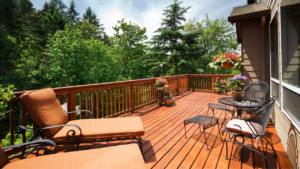
Decks and patios take a lot of abuse in Tallahassee’s climate — foot traffic, sun exposure, seasonal rainfall, and the relentless biological growth that thrives in Florida’s humidity. Keeping them clean and well-maintained extends their functional life significantly, but cleaning decks and patios incorrectly — using too much pressure, wrong technique, or skipping surface-appropriate pre-treatment — can cause damage that ranges from cosmetic (raised wood grain, lap marks on concrete) to structural (accelerated wood rot from moisture intrusion, displaced paver joints).
Wood Decks: Lower Pressure, Right Chemistry
Wood decks are the most technique-sensitive exterior surface for pressure washing. The same mechanical force that makes pressure washing effective on concrete becomes destructive on wood if applied incorrectly. The key principles:
PSI range: 500–800 PSI maximum for pressure treated pine and similar softwood decking. Hardwoods (ipe, teak) can tolerate slightly more pressure, but 1,000 PSI is still the upper limit for most hardwood deck applications. Higher pressure raises the grain (fuzziness on the surface after washing), splinters surface fibers, and drives moisture deep into the wood beyond what it can drain before stain or sealer application.
Nozzle selection: 40-degree (white) nozzle is standard for wood. This spreads the pressure across a wide enough angle to prevent concentrated impact damage. Never use a 15-degree or zero-degree nozzle on wood.
Direction matters: always wash with the grain, not across it. Washing across the grain on wood creates visible lap marks, pushes water into the end grain of boards, and raises the grain more aggressively than with-the-grain technique. Consistent with-the-grain passes, overlapping by 30–40%, produce uniform results.
Pre-treatment for biological growth: In Tallahassee, wooden decks develop mold, mildew, and green algae rapidly — especially shaded sections and boards near the ground. A diluted sodium hypochlorite pre-treatment (1–2% solution) applied to the deck surface and allowed to dwell 10–15 minutes before washing kills the organisms and makes them release more easily under low pressure. Without pre-treatment, you’re trying to mechanically blast biological growth off a porous surface — inefficient and requiring more pressure than the wood tolerates well.
Dry time before sealing: Pressure-washed wood needs to dry completely before any stain or sealer is applied — 48–72 hours minimum in Tallahassee’s humid summer conditions, longer if humidity remains high. Sealing over damp wood traps moisture and causes adhesion failure in the sealant film, bubbling, and mildew growth under the new finish.
Concrete Patios: More Forgiving, Still Needs Technique
Concrete patios tolerate much higher pressure than wood — 2,000–2,500 PSI is appropriate for standard poured concrete in good condition. The technique best practices remain important:
Surface cleaner attachment produces better results than wand cleaning for large patio areas. The even coverage prevents the zebra striping that single-nozzle cleaning creates, and the contained housing keeps overspray from hitting adjacent surfaces (siding, furniture, landscaping). For a 400+ square foot patio, a surface cleaner is dramatically faster and produces more consistent results.
Pre-treat biological growth on concrete patios with sodium hypochlorite solution before washing for longer-lasting results. Tallahassee patios, particularly shaded sections under a pergola or tree canopy, develop significant biological growth quickly. Pre-treatment kills the organisms; pressure washing alone displaces them and allows faster regrowth.
Stamped or decorative concrete patios need more care — treat like the upper range of wood (1,200–1,500 PSI maximum) to protect the surface color hardener and texture. These surfaces should be resealed after cleaning to protect the decorative finish.
Paver Patios: Joint Protection Is the Priority
Paver patios require the same cleaning approach as driveway pavers, with particular attention to joint sand preservation. The dense paver surface handles moderate pressure (1,500–2,000 PSI for most concrete pavers) but the joints are vulnerable to high-pressure erosion. Work across the paver faces, not into the joints. If joint sand is displaced during cleaning, replace it before the area is used — exposed joints allow weed germination and accelerate paver shifting.
After cleaning, assess whether the existing sealer is still providing adequate protection. A worn or degraded paver sealer allows biological growth to penetrate more quickly, makes the surface harder to clean next time, and allows staining to absorb into the paver surface. Most Tallahassee paver patios benefit from resealing every 2–3 years.
Professional Deck and Patio Cleaning in Tallahassee
Around The Bend Pressure Washing provides deck, patio, and outdoor surface cleaning throughout Tallahassee and surrounding areas. We match technique and pressure to each surface type, pre-treat biological contamination, and assess condition for maintenance recommendations. Serving Killearn Estates, Betton Hills, Southwood, Bradfordville, Crawfordville, Midway, Quincy, and Wakulla County. Call us at 850-888-2105.