Pressure washing is one of the home maintenance tasks that genuinely sits on the line between reasonable DIY and “call a professional.” Unlike electrical work or HVAC repair where the stakes of doing it wrong are high enough that most homeowners defer automatically, pressure washing sits in a gray area — consumer equipment is widely available, the basics aren’t complicated, and it feels achievable. For some jobs, it is. For others, the combination of technique risk, surface vulnerability, and the limitations of consumer equipment means professional service produces meaningfully better results and avoids damage that costs more to fix than the cleaning would have.
For homeowners in Wakulla County — Crawfordville, St. Marks, Sopchoppy, Panacea, and the surrounding area — the local environment adds specific factors worth understanding: coastal humidity and salt air, high biological growth rates from the combination of rainfall and heat, and homes with varied exterior materials that respond differently to pressure washing.
Where DIY Makes Sense
The clearest DIY territory is concrete hardscape — driveways, walkways, and patios — on single-story homes where access is straightforward. Concrete is forgiving material. It handles high pressure well, and technique mistakes — uneven coverage, occasional overlap marks — are visible briefly and wash out as the concrete dries evenly. A gas pressure washer at 2,500 PSI with a surface cleaner attachment, used on a concrete driveway, is a reasonable homeowner project with consumer equipment. The limiting factors are equipment quality and the time investment for a large driveway area.
Rinsing vehicles, outdoor furniture, and trash cans is another area where consumer pressure washers are perfectly adequate. These tasks don’t require professional-grade equipment or technique precision.
For motivated homeowners comfortable with ladders and precise technique, washing vinyl siding on a single-story home is also achievable with good consumer equipment — provided the siding is in good condition and you understand the critical rule about spray direction (always downward or horizontal, never upward into siding laps).
Where Professional Service Pays for Itself
Roofs are the clearest professional-only application. Pressure washing a roof with consumer equipment is likely to damage it — stripping granules from asphalt shingles, risking shingle lift from the sealing strips, and forcing water under tiles on barrel-tile roofs. Professional roof cleaning uses soft washing: 40–80 PSI with biocidal chemistry that kills algae, moss, and lichen without mechanical damage. This requires dedicated soft wash equipment — a chemical tank, downstream injector system, and calibrated delivery — that consumer pressure washers don’t replicate. In Wakulla County, where humidity and proximity to coastal air accelerate biological growth on roofing materials, professional roof soft washing every 2–3 years is essential maintenance, not optional cosmetic service.
Two-story exterior washing is another area where professional service makes sense for most homeowners. Working from an extension ladder at 20+ feet while directing a pressure wand across siding requires both hands on the wand, which means you’re operating without a proper three-point ladder contact. Falls from ladders at these heights cause serious injuries. Professional contractors have appropriate equipment — extension wands, commercial pressure washers with enough GPM to clean effectively from safe standoff distances, and experience with multi-story work — that changes the risk profile entirely.
Pool cages and screen enclosures require soft washing to avoid damaging the aluminum framing and fiberglass screen panels. High-pressure water bends frames and tears screens. Consumer equipment can damage an enclosure in seconds if directed at screen panels at close range or with too-aggressive nozzle selection. Professional pool cage cleaning with proper soft wash technique is both safer for the enclosure and more effective at removing the biological growth that causes discoloration.
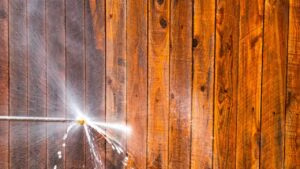
Wood surfaces — decks, fences, wood siding — require specific technique that many DIY attempts get wrong. Too much pressure raises the wood grain, drives moisture deep into the wood, and causes the painted or stained surface to peel. Not enough pressure doesn’t clean effectively. The correct approach typically involves chemical pre-treatment, low pressure (500–800 PSI), with-the-grain technique, and proper drying time before any sealant or stain is reapplied. Professionals also know when wood surfaces are past the point where cleaning helps and need replacement — a judgment call that homeowners without experience often miss.
The Equipment Gap Is Real
Consumer pressure washers — even quality ones at $300–$600 — max out around 2,000–2,500 PSI at 1.5–2.0 GPM. Professional commercial units run 3,000–4,000 PSI at 3.0–4.5 GPM. The cleaning power difference is substantial — a professional machine can deliver two to three times the cleaning units of consumer equipment. This translates directly to cleaning effectiveness on stubborn staining, speed on large surface areas, and the ability to clean surfaces thoroughly from a safer standoff distance.
For soft washing specifically, professional equipment includes chemical systems that consumer pressure washers simply can’t replicate. Downstream injection on consumer units dilutes cleaning solution to concentrations that are too weak for effective biological treatment. Professional soft wash systems maintain the 1–3% sodium hypochlorite concentration needed for genuine biocidal action throughout the application.
The Cost Comparison
The honest cost comparison between DIY and professional service for a typical Wakulla County home: renting a quality gas pressure washer costs $60–$100 per day. Buying one costs $300–$600+. Add cleaning solution, nozzle attachments, and your time (several hours for a full-house wash plus driveway). Against that, professional exterior cleaning packages in the Crawfordville and Wakulla County market typically run $275–$525 for a house wash, and $150–$325 for a driveway, depending on size and condition.
When the quality gap between professional results and consumer equipment is significant — particularly on house siding with biological contamination, where professional soft washing lasts 12–18 months versus 3–4 months for consumer pressure washing — the professional service often costs less per year of clean results even if the upfront price is higher.
Professional Pressure Washing in Wakulla County
Around The Bend Pressure Washing serves homeowners throughout Wakulla County — Crawfordville, St. Marks, Sopchoppy, Panacea, Medart, and Woodville. We also serve the broader Tallahassee metro area including Leon, Gadsden, and Jefferson counties. Whether it’s a full exterior house wash, roof soft washing, driveway cleaning, pool cage restoration, or deck cleaning, we use the appropriate method and equipment for each surface and each job.
Call us at 850-888-2105 to discuss your project and get a quote. We give honest assessments about what needs professional service versus what’s reasonable to tackle yourself.