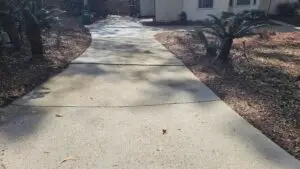
The short answer is yes — power washing can damage concrete if done incorrectly. But “done incorrectly” covers a specific set of mistakes that are entirely avoidable with the right equipment, technique, and understanding of how concrete behaves under high-pressure water. Most concrete damage from pressure washing comes from one of four causes: wrong PSI for the concrete condition, nozzle selection that concentrates force inappropriately, too-close standoff distance, or treating compromised concrete the same as sound concrete.
Here’s what actually causes damage, what doesn’t, and how to clean concrete effectively without causing problems — with specific attention to the conditions Tallahassee homeowners deal with.
What High Pressure Actually Does to Concrete
Sound, cured residential concrete mixed to standard 3,500–4,000 PSI compressive strength can handle pressure washing at 2,500–3,000 PSI without structural damage. The math might seem counterintuitive — the water pressure approaching the concrete’s compressive strength — but compressive strength is a measure of resistance to crushing force, not resistance to a moving water stream. Water at 3,000 PSI hitting concrete at a standard standoff distance doesn’t create compressive force anywhere near the concrete’s structural limits.
What high pressure can do is erode the paste layer — the cement-sand matrix at the concrete surface. On properly cured, sound concrete, this surface layer is hard and dense, and normal pressure washing doesn’t meaningfully erode it. On concrete that has been compromised by freeze-thaw damage, chemical attack, or inadequate curing, the surface paste layer is weaker and more porous. High-pressure water directed at this compromised layer can accelerate surface erosion, expose aggregate, and widen existing micro-cracks.
In Tallahassee, the primary aging mechanisms for concrete are UV exposure, thermal cycling from seasonal temperature variation (not freeze-thaw, but the cycle from cool winters to 95°F summers still stresses the surface), ground movement from Leon County’s expansive red clay soils, and root intrusion from the area’s extensive tree canopy. Concrete that has developed surface spalling, scaling, or visible cracking from these factors should be treated at lower pressure — 1,500–2,000 PSI — than sound concrete.
The Specific Mistakes That Cause Concrete Damage
Using a zero-degree (red) nozzle for general washing is the single most common cause of concrete scarring from DIY pressure washing. The zero-degree nozzle concentrates all the pressure into a pinpoint stream that has the force of a cutting tool at close range. A few seconds of direct zero-degree spray on concrete at 3,000 PSI from 6 inches will etch a visible groove. This nozzle has legitimate uses — removing rust spots, blasting debris from deep cracks — but is not appropriate for general driveway washing. Use a 25-degree green nozzle or surface cleaner attachment for large concrete areas.
Holding the nozzle too close to the surface multiplies the effective pressure at the impact point. A 3,000 PSI washer with a 25-degree nozzle at 12 inches is appropriate for sound concrete. The same washer at 4 inches from the surface delivers far more concentrated force and can scar even good concrete with extended exposure. The standard guidance is to keep a 12–18 inch standoff for driveway concrete with a 25-degree nozzle.
Dwelling in one spot is the other common cause of surface damage. Moving the wand at a consistent pace allows even water distribution across the surface. Stopping or slowing over a stubborn spot while the full pressure continues to impact the same area accumulates damage over time. The correct response to a stubborn stain is pre-treatment chemistry, not more dwell time with the wand at the same spot.
Concrete Conditions That Require Extra Caution
Older driveways showing surface spalling, exposed aggregate, or pitting need lower pressure than new concrete. If the surface looks rough or irregular — if the top layer has broken away in places revealing the aggregate underneath — that’s a sign the surface cement matrix has weakened. Treat at 1,500–2,000 PSI maximum and test a small area before proceeding.
Concrete with existing cracks — even hairline cracks — can have water forced into the crack under high pressure, potentially widening it or driving water into the sub-base. For cracked concrete, reducing pressure and standoff distance from cracks, or hand-cleaning crack areas, prevents water infiltration that could accelerate the existing damage.
Stamped or decorative concrete has surface texture that was pressed into the wet concrete and a colored hardener applied to the surface. High-pressure washing can erode the surface hardener layer, fading the color. Stamped concrete should be cleaned at 1,500–2,000 PSI maximum and re-sealed regularly to protect the decorative surface.
Pre-Treatment Makes the Difference on Stained Concrete
For the biological staining common on Tallahassee driveways — the green algae and black mold that appears quickly in our climate — pre-treatment with a diluted sodium hypochlorite solution (3–5% concentration) before washing produces far better results than pressure alone. Apply the solution, let it dwell 10–15 minutes, then wash. The chemistry kills the organisms at the root level; the pressure rinses away the dead matter and residual solution. This combination cleans more thoroughly at lower effective pressure than trying to blast biological staining away mechanically.
Oil staining from vehicle drips — common on driveway aprons and garage approach areas — requires a degreaser pre-treatment. Alkaline degreasers break the petroleum-concrete bond; apply, scrub in, let dwell, then wash. Without pre-treatment, even very high pressure won’t fully remove oil staining because it has penetrated below the surface layer.
Professional Concrete Cleaning in Tallahassee
Around The Bend Pressure Washing handles driveway and concrete cleaning throughout Tallahassee and the surrounding area. We assess concrete condition before choosing pressure settings, pre-treat biological and oil staining, and use surface cleaner attachments that distribute pressure evenly rather than single-nozzle wand washing that creates uneven coverage. If your concrete is stained, discolored from biological growth, or showing years of accumulated grime, call us at 850-888-2105 for a quote.