The Best Conditions for Pressure Washing: A Practical Guide from Around the Bend
Pressure washing on the right day, in the right conditions, with the right sequence produces results that hold for 12–18 months. Pressure washing under the wrong conditions — on a surface still wet from yesterday’s rain, in peak afternoon heat, or immediately before a storm front — can mean the cleaning underperforms, the chemical treatment doesn’t work, or the job simply needs to be redone. This guide covers what ideal conditions look like for each type of exterior cleaning we do across Tallahassee, Wakulla County, and the surrounding region — and why it matters for the homes and properties we work on every week.
Temperature and Its Role
North Florida sits in a subtropical climate that rarely deals with the cold-weather limitations that affect pressure washing in northern states. Freezing temperatures are uncommon and brief in the Tallahassee area — a hard freeze a few nights per year at most. For most of our service calendar, temperature isn’t a limiting factor for concrete and hardscape work. Where temperature becomes significant is soft wash applications: sodium hypochlorite chemistry works most effectively between 60°F and 85°F.
During Tallahassee’s summer months (June–September), surface temperatures on dark roofing, asphalt driveways, and south-facing stucco can reach 130–150°F in direct afternoon sun. At these surface temperatures, sodium hypochlorite solutions applied at standard dwell concentrations can off-gas and lose effectiveness before the full 10–20 minute contact time is achieved. Our crews respond to this by scheduling roof treatments and house wash applications for morning hours — starting between 7:30 and 9:00 AM — when surface temperatures are at their daily minimum and allow adequate chemistry dwell time before the sun reaches peak intensity.
Rain and Moisture: Timing Around the Wet Season
Tallahassee receives over 60 inches of rain annually, with the majority concentrated in the May–September wet season. Daily afternoon thunderstorms are routine from July through August. This pattern shapes how we schedule exterior cleaning jobs and when we advise customers to book.
For concrete and hardscape pressure washing, recent rain isn’t necessarily a problem — wet concrete can be effectively cleaned, and the runoff from the cleaning process disperses normally on already-saturated ground. Where rain timing matters most is soft wash applications (house washing, roof treatment) and any job that includes sealing or coating after the clean.
Soft wash chemistry on a surface that’s still running with water from recent rain is diluted before it can achieve adequate dwell time. We typically prefer working on surfaces that have been dry for at least 12–24 hours before a house wash or roof treatment — surfaces don’t need to be completely cured dry, but they shouldn’t be actively wet or covered with standing water from the previous day’s rain. For the afternoon thunderstorm pattern, morning scheduling takes care of this automatically: surfaces dry overnight, we work in the morning, and any afternoon rain arrives after the chemistry has been fully rinsed and the job is complete.
For jobs that involve concrete sealing after pressure washing, rain timing is more critical. Sealers require dry, cured concrete for proper bonding and cure — rain within 24 hours of sealer application prevents proper cure and typically requires the sealing to be reapplied. We schedule seal-and-coat jobs for dry weather windows, which are most reliably found from October through April in Tallahassee’s climate.
Seasonal Conditions by Surface Type
Driveways and Concrete
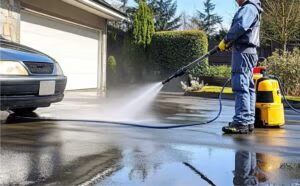
Concrete cleaning is our most weather-flexible service. We can clean driveways effectively in most conditions short of active rain and hard freeze. Light overcast is actually preferable to direct summer sun for large concrete jobs — cooler surface conditions allow degreaser pre-treatments more working time, and the crew works more efficiently in lower ambient temperatures. Many of our concrete jobs in Killearn Estates, Southwood, and Bradfordville neighborhoods get scheduled for October through April when the combination of dry weather and moderate temperatures makes for optimal working conditions and results.
House Washing
House washing in Tallahassee is primarily a spring and fall service for most customers. The spring window (March–May) catches homes after the heavy pollen season when oak and pine pollen has coated every surface and is feeding biological growth going into the wet season. Cleaning in this window removes the pollen accumulation and kills biological growth before the wet season’s warmth and moisture drive it to its fastest growth rate. The fall window (October–November) removes the wet season’s biological accumulation, tannin staining from summer leaf fall, and resets the exterior heading into the holiday season.
For customers who need house washing during summer months — before a special event, after particularly heavy growth has developed — morning scheduling and careful forecast work allow us to perform effective house washes through the wet season. We just plan around the afternoon pattern rather than fighting it.
Roof Treatment
Roof soft wash is best performed in cooler weather with dry forecasts — our preferred window is October through April. The lower surface temperatures allow full chemistry dwell time on hot Tallahassee roofs, the drier conditions mean less dilution from surface moisture, and wind is typically calmer in cooler months which reduces chemical drift concerns during application. For customers in Killearn Lakes, Betton Hills, and Waverly Hills with asphalt shingle roofs showing significant Gloeocapsa magma streaking, scheduling the roof treatment in fall or early spring delivers the best single-treatment results.
Pool Cages and Screened Enclosures
Pool cage cleaning is appropriate year-round — aluminum and screen materials aren’t particularly weather-sensitive for cleaning purposes. The most popular scheduling window is spring before swim season begins, when the enclosure’s winter accumulation of pollen, algae, and organic debris is cleaned off before the pool gets regular use again. Fall cleaning after heavy leaf drop from Tallahassee’s oak and sweet gum canopy is the second most common timing — clearing the debris before it compresses and stains the screen panels through winter.
Planning Your Cleaning Around Tallahassee’s Calendar
Our scheduling recommendation for most Tallahassee homeowners: a spring cleaning (April–May) for house exterior, pool cage, and any concrete that accumulated winter debris and spring pollen, and a fall cleaning (October–November) for post-wet-season reset. Homes with heavy tree cover in Bradfordville, Ox Bottom, Killearn Estates, and areas near the Apalachicola National Forest may benefit from a third service for gutters and high-debris surfaces mid-summer.
We serve Tallahassee, Wakulla County, Crawfordville, Woodville, Quincy, Midway, Bradfordville, Killearn Estates, Killearn Lakes, Southwood, Midtown, Waverly Hills, and Ox Bottom. Call 850-888-2105 to talk through the right timing for your property or to get on the schedule for your preferred cleaning window. We’ll recommend the approach that makes the most sense for your surfaces and your calendar.