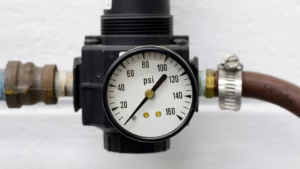
House washing PSI is probably the most frequently asked technical question in the exterior cleaning space — and one of the most important to get right. Using too much pressure on the wrong surface is one of the most common ways homeowners damage their own homes while trying to maintain them. The correct answer isn’t a single number; it depends on what the house is made of.
The General Rule: Lower Than You Think
For house washing — cleaning the vertical exterior surfaces of a home — the appropriate PSI range is much lower than for driveway cleaning. Most exterior wall surfaces require 500–1,500 PSI depending on material, not the 2,500–3,000 PSI appropriate for concrete. The contamination on siding is almost always biological (algae, mildew, mold) and responds to cleaning chemistry, not mechanical force. High pressure removes the growth visually but often causes surface damage in the process.
For homes where biological contamination is the primary issue — which describes almost every Tallahassee home that hasn’t been cleaned recently — soft washing at 40–80 PSI with an appropriate sodium hypochlorite solution is more effective and far safer than any pressure washing approach. This is the method professional contractors increasingly use for exterior house washing because it produces better results with less risk.
PSI by Siding Type
Vinyl siding can handle moderate pressure — 1,000–1,500 PSI — but lower is still better for biological contamination. The critical technique rule with vinyl is spray direction: always wash downward or horizontally, never upward. Upward spraying forces water behind the vinyl panel laps, where it has nowhere to drain and creates moisture conditions for rot and mold in the wall cavity. A 40-degree white nozzle at 12–18 inch standoff, spraying downward, is the correct technique for vinyl. If you’re dealing primarily with mildew and algae (typical in Tallahassee), pre-treat with a soft wash solution and use the pressure wash as a rinse rather than the primary cleaning agent.
Painted wood siding — clapboard, shiplap, or similar horizontal wood siding — needs significantly lower pressure than vinyl: 500–800 PSI maximum using a 40-degree nozzle. High pressure raises the wood grain, drives water into the wood fiber beyond what it can drain, and strips paint from surfaces that are in anything less than perfect adhesion condition. For painted wood, the approach should be chemical pre-treatment followed by gentle low-pressure rinsing. If the paint is already showing any peeling or bubbling, high-pressure washing will accelerate failure dramatically.
Stucco is the surface where DIY pressure washing causes the most damage, and it’s common in older Tallahassee neighborhoods — Betton Hills, Midtown, Myers Park, and similar areas have significant stucco-exterior housing stock. Stucco looks hard but the surface layer is typically 3/8 to 3/4 inch thick and can crack under high-pressure impact, particularly where hairline cracks have already developed. Maximum 1,000–1,200 PSI with a 40-degree nozzle at 24-inch standoff, and test an inconspicuous area first. Any existing cracks should be repaired before cleaning. If the stucco has significant cracking, professional soft washing is safer than any pressure approach.
Fiber cement siding (Hardie board) is increasingly common in newer Tallahassee construction and handles pressure washing better than wood or stucco — similar parameters to vinyl, 1,000–1,500 PSI with a 40-degree nozzle spraying downward. The cut edges of fiber cement panels are the vulnerable point; never direct high-pressure spray at exposed cut edges, particularly at the bottom course near the foundation.
Brick and stone exterior walls can generally handle higher pressure — 1,500–2,000 PSI for well-set brick in good condition — but mortar joints are the limiting factor. Deteriorating mortar erodes rapidly under high-pressure water. For brick with any mortar concerns, reduce pressure and use wide-angle nozzle at appropriate standoff distance. Test before cleaning the full facade.
Why Soft Washing Outperforms Pressure Washing for Florida Homes
For Tallahassee homeowners, the PSI question for house washing is somewhat secondary to the method question. In this climate, the primary contamination on exterior walls is biological — the same algae, mold, and mildew cycle that affects roofs and driveways. Pressure washing at any PSI removes visible growth but leaves behind spores and root structures that regenerate quickly: typically 2–4 months in Tallahassee’s warm, humid climate before visible regrowth appears.
Soft washing kills the organisms with biocidal chemistry at low delivery pressure (40–80 PSI), leaving a residual that suppresses new germination for months. Results typically last 12–18 months on Florida siding. The lower delivery pressure means no risk of surface damage to vinyl, painted wood, stucco, or fiber cement. It’s both safer and more effective for the specific cleaning challenge Florida homes face.
Professional House Washing in Tallahassee
Around The Bend Pressure Washing provides exterior house washing throughout Tallahassee and the surrounding area. We use soft washing for biological contamination — the standard for Florida homes — and match pressure and nozzle selection to specific surface materials. Call us at 850-888-2105 for a quote on your home’s exterior.