The Hidden Dangers of a Dirty Driveway in Tallahassee
A dirty driveway might seem like a cosmetic problem — something that makes the house look less maintained than it actually is. But in Tallahassee’s climate, what accumulates on a driveway is actively creating hazards and surface damage that go well beyond appearances. This post covers the specific risks that buildup on concrete driveways creates in North Florida, why they develop faster here than in most climates, and what professional cleaning actually prevents rather than just correcting.
Slip and Fall Hazards: The Most Immediate Risk
Algae and biological growth on concrete driveways creates one of the most dangerous surfaces a homeowner can have near their property: wet algae on concrete is nearly frictionless underfoot. After rainfall — which Tallahassee receives more than 60 inches of annually — algae-covered driveways become genuinely hazardous walking surfaces. The risk is highest on shaded sections under tree canopy where algae growth is densest and the surface stays wet longer after rain.
Homes in Killearn Estates, Betton Hills, and Bradfordville with significant canopy overhead often have driveways where north-facing or shaded sections develop dense algae cover that’s nearly invisible when dry but becomes a slip hazard immediately after any moisture. The green tint blends with the surrounding concrete and can be missed by someone not looking for it — a guest, a delivery person, an elderly visitor, or a child running toward the house after being dropped off.
Liability exposure for homeowners is also a real consideration. Florida premises liability law holds property owners responsible for maintaining reasonably safe conditions for invited guests. A slip-and-fall on a driveway with documented algae growth — visible in photographs and present for an extended period — is a liability exposure that makes the cost of regular driveway cleaning look minimal by comparison.
Concrete Degradation from Embedded Staining
Concrete is porous, and Tallahassee driveways accumulate staining that penetrates progressively deeper into the substrate the longer it’s left untreated. Motor oil and petroleum products don’t just sit on the surface — they migrate down into the concrete’s pore network, carrying other contaminants with them and eventually reaching a depth where mechanical cleaning can no longer extract them. The iron-rich red clay soil common in Leon County creates tannin staining that similarly embeds with time.
Fresh staining is dramatically easier to remove than staining that’s been in concrete through multiple Florida wet seasons. An oil stain treated at six months typically removes completely in one professional cleaning pass. The same stain left for three years may be permanent — the oil has oxidized and polymerized within the concrete pores, becoming a chemical part of the substrate rather than a surface contaminant. Regular cleaning prevents this progression and maintains the concrete’s appearance and resale-readiness.
Weed Growth at Concrete Joints
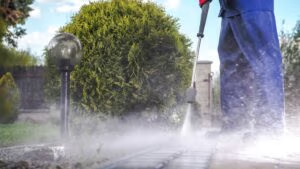
The expansion joints and cracks in concrete driveways accumulate organic debris — soil, decomposing leaf matter, pollen — that becomes a growing medium for weeds and grass. In Tallahassee’s growing climate, joints that are clean in spring can have established weed growth by summer’s end. These weeds aren’t just cosmetically unwanted: their root systems physically expand the joint gaps and surface cracks, accelerating the concrete deterioration that begins small and becomes progressively more expensive to address as the cracks widen.
Pressure washing concrete joints with appropriate PSI clears the accumulated organic debris that supports weed establishment. Pairing this with a post-clean joint sealing maintains the debris clearance between cleanings. Homes in Southwood, Killearn Lakes, and Crawfordville with older concrete driveways that have developed significant crack networks benefit most from this approach — maintaining what’s there rather than allowing the biological loading in cracks to accelerate the crack’s growth.
Damage to Vehicles from Contaminated Driveways
Vehicles parked on contaminated driveways can pick up oil, chemical residue, and biological material from the surface on their tires — and redistribute it into garages, onto garage floors, and onto painted driveway sections that weren’t originally contaminated. Motor oil drips from a vehicle pool on the concrete directly under the vehicle, then spread in a thin film as the vehicle drives over them repeatedly. A single oil leak spot becomes a smeared contamination zone covering a much larger area over months of regular parking.
The oil then tracks into the garage where it’s more difficult to clean from the garage floor surface. For homes planning concrete coating or garage floor epoxy application — a popular upgrade in Tallahassee homes in Midtown, Waverly Hills, and newer neighborhoods — a driveway that’s been redistributing oil onto the garage floor requires more aggressive degreasing preparation before the coating can achieve proper adhesion.
Drainage Problems from Debris Accumulation
Organic debris — leaves, pine needles, sweet gum balls — accumulates in driveway gutters, drain channels, and low spots. In Tallahassee’s heavy rainfall events (2–4 inches in an afternoon during wet season), blocked drainage channels can cause water to back up onto the driveway surface, against the garage foundation, or toward the house foundation rather than draining away from the structure as designed. This redirected drainage contributes to the same foundation moisture problems caused by clogged gutters — the root cause is the same: organic debris blocking designed drainage paths.
Professional driveway cleaning clears drain channels and gutters at the driveway perimeter as part of the service, maintaining the drainage function that the driveway’s design provides. This is especially important for driveways with center-drain or perimeter-drain channel systems that are common in Tallahassee’s newer neighborhoods.
First Impressions and Neighborhood Standards
The appearance dimension is real even if it’s not a safety or structural issue. In Tallahassee’s competitive real estate market — active in Killearn Estates, Southwood, Betton Hills, and throughout the city — a clean, well-maintained driveway contributes meaningfully to the first impression a home makes. Prospective buyers, appraisers, and neighbors all form judgments based on exterior condition, and a dirty, stained driveway signals neglect even when the rest of the property is well-maintained.
HOA communities in Tallahassee increasingly include exterior maintenance standards that specifically address algae growth, staining, and organic debris accumulation. A driveway that would trigger an HOA notice or affect neighborhood harmony is avoidable with straightforward annual cleaning — a much lower cost than the fines, stress, and neighbor relations damage that repeated notice violations create.
Address the Problem Before It Compounds
The common thread across all the hidden dangers of a dirty driveway is that they compound over time. Slip hazards grow with algae coverage. Concrete staining penetrates deeper. Weed roots widen cracks. Drainage blockages increase with debris accumulation. Addressing the problem on a regular annual or semi-annual schedule is dramatically less costly — in money, time, and risk — than waiting for the problems to become severe.
Around the Bend Pressure Washing serves Tallahassee, Bradfordville, Killearn Estates, Killearn Lakes, Southwood, Midtown, Waverly Hills, Ox Bottom, Crawfordville, Woodville, Quincy, and Midway. Professional driveway cleaning with commercial equipment, appropriate degreaser pre-treatment, and surface cleaner technique that eliminates striping — call 850-888-2105 to schedule or get a quote. Don’t wait until the hidden dangers of a dirty driveway become visible and expensive problems.