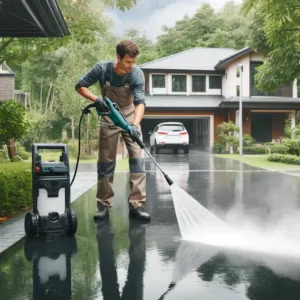
Pressure washing is widely understood as an effective cleaning method, but its environmental footprint is less often discussed. Water consumption, chemical runoff, and the downstream effects on Tallahassee’s waterways are real considerations — and ones that responsible contractors take seriously. Understanding where the environmental risks actually exist, and how they’re mitigated through proper technique and product selection, helps homeowners make informed decisions about exterior cleaning.
Water Consumption in Context
A professional pressure washing setup running at 4 GPM uses roughly 240 gallons per hour of operation. A full residential house wash typically runs one to two hours of active washing time — so 240 to 480 gallons per visit, depending on property size and conditions. For comparison, a standard lawn irrigation cycle on a typical Tallahassee residential lot uses 100 to 200 gallons, and a 10-minute shower uses about 25 gallons.
The more relevant comparison is against the alternative: extended scrubbing with a garden hose, which runs at 5 to 10 GPM continuously while producing far less cleaning force. Professional equipment’s higher GPM is offset by significantly shorter total job time, and the cleaning accomplished per gallon used is far higher. Water efficiency in pressure washing is about the relationship between flow, pressure, and result — not the flow rate in isolation.
For Tallahassee properties on municipal water, consumption is metered and paid for. For properties in Woodville, Wakulla County, or rural Bradfordville on wells, high-volume equipment that exceeds the well’s recovery rate is a practical concern that any reputable contractor should discuss before starting work.
Chemical Runoff: The Real Concern
The environmental consideration that matters most in residential pressure washing is chemical runoff — specifically, how soft wash solutions containing sodium hypochlorite interact with landscaping, soil, and stormwater systems when they drain away from treated surfaces.
Sodium hypochlorite at residential soft wash concentrations — 0.5 to 1.5% for house wash, 2.5 to 4% for roof treatment — degrades rapidly in soil and sunlight. It doesn’t persist in groundwater the way synthetic pesticides or petroleum products do. At working dilution, it breaks down into sodium chloride (salt) and oxygen through photolytic decomposition within hours of soil contact. This relatively favorable environmental profile is one reason it remains the standard active ingredient for organic growth removal in the pressure washing industry.
However, concentration and application method matter. Careless over-application — using higher concentrations than necessary, applying in windy conditions with significant overspray, or failing to rinse landscaping before and after treatment — can cause bleaching damage to lawn and garden plantings. Responsible soft wash application always includes pre-wetting adjacent landscaping with clean water, which dilutes any chemical that contacts plant material, and a post-rinse to flush residual solution away from soil contact areas.
Stormwater and Local Waterways
Tallahassee sits at the northern edge of Florida’s karst limestone geology, with significant groundwater connectivity through sinkholes, seeps, and springs throughout the metro area and into Wakulla County. Stormwater in Tallahassee ultimately drains to local creeks, the St. Marks River watershed, and eventually to the Apalachee Bay. What goes into storm drains and natural drainage pathways has real downstream consequences.
For residential soft washing, the diluted nature of runoff and the rapid degradation of sodium hypochlorite means that properly conducted house and roof washing presents minimal risk to these waterways. The surfactants used in professional soft wash formulations are biodegradable and break down in soil. The biological material being removed — algae, mildew, lichen — is itself organic and degrades naturally when rinsed into drainage.
Where stormwater management becomes critical is commercial pressure washing: parking lots, drive-throughs, and industrial surfaces where oil, grease, heavy metals from brake dust, and petroleum products concentrate. Washing these surfaces without containment systems sends contaminated water directly to stormwater infrastructure. For commercial work in Tallahassee, responsible contractors use containment berms and pump-out systems to capture and properly dispose of wastewater from hydrocarbon-contaminated surfaces — this is both a best practice and increasingly a regulatory requirement.
Protecting Your Landscaping
Tallahassee homeowners in established neighborhoods like Killearn Estates, Betton Hills, Southwood, and Killearn Lakes often have significant investments in mature landscaping — ornamental beds, established shrubs, heritage trees, and lawn areas that represent years of growth. Protecting these during exterior cleaning is both practical and environmentally responsible.
The most effective protection is the pre-wet and post-rinse protocol described above. Beyond that, experienced contractors avoid direct application of soft wash solutions to plant material, direct roof runoff containing concentrated chemical away from foundation plantings during treatment, and use targeted application rather than broadcast spraying near sensitive areas. If you have newly installed plants, recently sodded lawn areas, or known sensitive species near the work zone, flagging these for the contractor before work begins is worthwhile.
Choosing Environmentally Responsible Products
The pressure washing industry has moved toward more environmentally favorable formulations over the past decade. Phosphate-free surfactants are now standard in professional products, eliminating a key driver of algal bloom growth in waterways. Citrus-based and plant-derived cleaners are effective alternatives to petroleum-based products for organic staining on concrete and wood. For wood brightening, oxalic acid is effective and has a more benign environmental profile than some older alternatives.
When evaluating contractors, asking about their chemical formulations is legitimate. A professional contractor should know exactly what products they’re using, be able to provide safety data sheets if requested, and be able to explain their application practices around landscaping and drainage. Vague answers here are a yellow flag.
The Bigger Picture: Maintenance Prevents Worse Outcomes
Regular exterior maintenance — annual or semi-annual washing on appropriate schedules — is more environmentally efficient than reactive cleaning. Surfaces maintained regularly require less chemical, less water, and less time per cleaning than surfaces cleaned for the first time after two or three years of neglect. A home that hasn’t been washed in three years requires heavier chemical concentrations, more passes, and more total water volume to achieve the same result as a home on an annual maintenance schedule.
From an environmental standpoint, scheduled maintenance reduces cumulative chemical and water inputs over time compared to deferred cleaning. It also protects surface materials, reducing the need for premature replacement — manufacturing new siding, roofing, or concrete has a far larger environmental footprint than maintaining what exists.
Responsible Pressure Washing in Tallahassee
Around the Bend Pressure Washing uses professional-grade biodegradable soft wash chemistry, follows plant protection protocols on every job, and applies appropriate techniques for each surface type. We serve Tallahassee and surrounding communities including Killearn Estates, Killearn Lakes, Bradfordville, Southwood, Betton Hills, Waverly Hills, Midtown, Woodville, Crawfordville, Quincy, and Midway.
Call 850-888-2105 to schedule or to ask questions about our approach to responsible exterior cleaning. We’ll walk through the work with you and explain exactly what we’re doing and why.