Keeping your home’s exterior clean doesn’t have to conflict with caring about water conservation, chemical use, or the health of your yard and local waterways. Sustainable pressure washing is less about choosing between cleanliness and responsibility and more about how the work gets done — the right techniques, appropriate products, and sensible scheduling that achieves great results with the smallest reasonable footprint.
For homeowners in Tallahassee, where the proximity to springs, creeks, and the St. Marks watershed makes stormwater quality a real local concern, these practices matter. Here’s what sustainable pressure washing actually looks like in practice.
Use the Right Pressure — No More, No Less
Over-pressuring surfaces is the most common inefficiency in pressure washing, and it wastes water, time, and surface integrity simultaneously. Each surface type has a range where pressure does useful work without causing damage or requiring additional passes — and staying within those ranges is both effective and efficient.
For house siding, the soft wash method — 100 to 600 PSI rinse combined with sodium hypochlorite chemistry at 0.5 to 1.5% — is more effective than high-pressure washing and uses less water volume per square foot of surface cleaned. The chemistry does the work of killing biological organisms; the low-pressure rinse removes the dead material. High pressure on siding doesn’t kill the organisms — it temporarily removes visible growth that regrows quickly, meaning more frequent cleaning and more total water use over time.
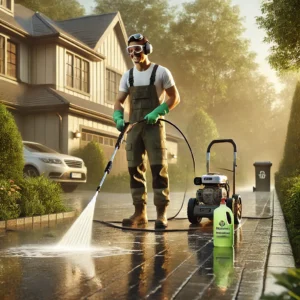
For concrete, 3,000 to 3,500 PSI with a surface cleaner is the efficient range — enough to lift embedded debris without excessive water velocity that wastes volume on splatter rather than cleaning work. Running higher pressure than needed doesn’t clean better; it etches concrete surfaces over time and creates more turbulent runoff that carries debris farther from the work area.
Choose Biodegradable Chemistry
Modern professional-grade pressure washing products offer effective cleaning with environmental profiles far better than older-generation chemistry. For house washing and roof treatment, sodium hypochlorite remains the active ingredient — it’s effective, breaks down rapidly in soil and sunlight into benign byproducts, and doesn’t persist in groundwater. The surfactants used to carry and spread soft wash solutions are available in phosphate-free, biodegradable formulations that break down in soil and don’t contribute to algal bloom problems in local waterways.
For concrete cleaning, citrus-based degreasers address organic staining effectively without the environmental concerns of petroleum-based products. For wood surfaces, oxalic acid-based brighteners are effective and have a reasonable environmental profile. Asking your contractor specifically which products they use — and whether those products are phosphate-free and biodegradable — is a fair question that any reputable operation should answer readily.
Protect Landscaping Before You Start
Pre-wetting the landscaping adjacent to any work area is standard practice for conscientious contractors, and it makes a significant difference in chemical impact on plants. Saturating shrubs, ground cover, and lawn areas with clean water before applying soft wash solution dilutes any overspray that contacts plant material. A post-rinse after the work area is treated flushes residual chemical away from root zones.
In established Tallahassee neighborhoods like Killearn Estates, Betton Hills, and Waverly Hills, where mature landscaping represents real investment, this protocol protects both the plants and the soil biology beneath them. For homeowners in Bradfordville or Killearn Lakes with vegetable gardens or sensitive native plantings near the house, flagging those areas specifically for any contractor is worth doing before work begins.
Manage Runoff Thoughtfully
Where wash water drains matters, particularly for surfaces with concentrated soil loads. Residential soft washing runoff — primarily diluted sodium hypochlorite, surfactants, and the organic material removed from surfaces — is relatively low-concern when it drains to lawn areas and soil, where it infiltrates and biodegrades. Runoff going directly to stormwater curbs and drains bypasses the filtration and dilution that soil provides, sending chemical and debris loads directly toward local waterways.
For most residential house washes, this is managed simply by directing rinsing toward lawn and garden areas where possible rather than hard-surfacing runoff paths. For driveways and concrete areas — particularly those with oil, grease, or heavy biological load — containing and diverting wash water before it reaches the storm drain is more important. Simple berms and drain covers are available and used by environmentally conscious contractors on jobs where stormwater management matters.
This is especially relevant for Tallahassee properties near retention ponds, drainage swales, or the wooded drainage corridors common throughout Woodville, Wakulla County, and the areas south of town that drain toward the St. Marks watershed.
Schedule Maintenance Proactively
The most sustainable cleaning schedule is also the most economical one: regular annual maintenance rather than reactive cleaning after heavy buildup. A home washed annually uses less chemical per visit, requires less total water volume, and produces less concentrated runoff than a home washed for the first time in three years. Heavy biological accumulation that’s had time to establish deep root systems in siding and concrete requires stronger chemistry, more passes, and more time — multiplying every environmental input compared to maintaining clean surfaces from year to year.
Annual soft washing in late winter or early spring — before Tallahassee’s wet season ramps up and humidity stays continuously high — is the most efficient timing for both cleaning results and environmental impact. Surfaces treated in February or March stay cleaner longer before the summer humidity accelerates regrowth.
Consolidate Services to Reduce Site Visits
Bundling house washing, driveway cleaning, and other exterior services into a single annual visit reduces total fuel consumption, equipment setup time, and site disturbance compared to separate visits for each service. For properties that need both a house wash and a roof treatment, scheduling both together is more efficient than two separate mobilizations — and most contractors offer combined pricing that reflects the efficiency.
This applies to commercial properties as well. A quarterly parking lot cleaning scheduled with a semi-annual building facade wash on a rolling maintenance program uses less total contractor mobilization than reactive, as-needed service for each surface separately.
Work With Contractors Who Share These Values
Sustainable pressure washing is ultimately about finding a contractor who applies techniques and products thoughtfully — who knows why proper chemical dilution matters, why pre-wetting landscaping is standard practice, and why running the right pressure for the surface rather than maximum pressure for everything produces better results with less impact.
Around the Bend Pressure Washing uses biodegradable soft wash chemistry, practices plant protection on every job, and applies surface-appropriate techniques throughout Tallahassee and surrounding communities including Killearn Estates, Killearn Lakes, Bradfordville, Southwood, Betton Hills, Waverly Hills, Midtown, Woodville, Crawfordville, Quincy, and Midway.
Call 850-888-2105 to schedule or to discuss how we approach responsible exterior cleaning on your property.
1 thought on “Sustainable Pressure Washing Practices for the Eco-Conscious Tallahassee Homeowner”
Pingback: The Environmental Impact of Pressure Washing: What You Should Know - Tallahassee Pressure Washing Services