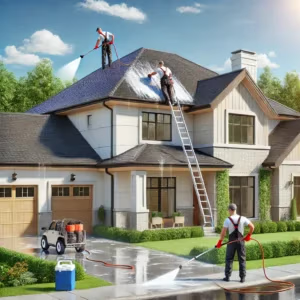
These two terms get used interchangeably in a lot of marketing material, but soft washing and power washing are genuinely different techniques with different equipment, different chemistry, and different ideal applications. Using the wrong method on the wrong surface doesn’t just mean a subpar clean — it can cause damage that costs more to fix than the original cleaning job would have saved you.
Here’s a practical breakdown of how each method actually works, where each one is appropriate, and how to think about this decision as a Tallahassee homeowner dealing with Florida’s specific cleaning challenges.
What Is Power Washing?
Power washing uses high-pressure water delivered through a motorized pump system to blast contaminants off surfaces. Residential pressure washers typically operate between 1,500 and 3,000 PSI. Commercial-grade equipment used by professional contractors can go higher, though for most exterior cleaning tasks anything over 3,000 PSI is unnecessary and increasingly risky to surfaces.
The “power” in power washing comes from mechanical force — the water stream is moving fast enough to physically dislodge dirt, organic growth, paint, and other surface contaminants. The nozzle choice determines how that force is concentrated. A 0-degree red nozzle concentrates all the force into a single cutting point — useful for stripping rust or heavy paint but dangerous near most surfaces. A 15-degree yellow nozzle is still aggressive, appropriate for concrete or heavy masonry. A 25-degree green nozzle is a general-purpose setting. A 40-degree white nozzle disperses pressure across a wider area, making it safer for painted surfaces and wood. A soap nozzle (black, often 65 degrees) drops pressure for detergent application.
It’s worth noting: the terms “pressure washing” and “power washing” are used almost interchangeably by most consumers and many contractors. Technically, some definitions reserve “power washing” for heated-water systems where the water is heated to 140–311°F before delivery. Heated water is significantly more effective at cutting through grease, gum, and oil-based stains. For most residential applications, though, you’ll encounter cold-water pressure washing regardless of what it’s called.
What Is Soft Washing?
Soft washing uses low pressure — typically 40–80 PSI — paired with a cleaning solution to do what pressure alone cannot. Where power washing relies on mechanical force to remove contaminants, soft washing relies on chemistry. The solution does the work; the pressure just rinses.
The standard soft wash solution is a sodium hypochlorite (bleach) base at 1–3% concentration, combined with a surfactant that reduces surface tension so the solution spreads evenly and clings to vertical surfaces during the dwell period. The sodium hypochlorite is a broad-spectrum biocide — it kills algae, mildew, mold, bacteria, lichen, and other organic matter at the cellular level rather than just washing it off visually.
This distinction matters enormously in Tallahassee’s climate. When you power wash algae off a surface, you remove the visible growth but leave behind spores and root structures. Regrowth typically appears within 2–4 months. When you soft wash the same surface, the biocide kills the organism and leaves a residual that suppresses new spore germination for months — often a full year or more depending on conditions. You’re treating the cause, not just the symptom.
The Critical Difference for Tallahassee Homeowners
Florida’s climate creates a specific cleaning challenge that most of the general online advice about pressure washing doesn’t account for. Tallahassee averages over 60 inches of rainfall annually. Humidity sits above 70% for months at a stretch. We have one of the highest urban tree canopy densities in the country. The combination produces persistent biological contamination — algae, mold, mildew, lichen — on virtually every outdoor surface exposed to shade and moisture.
In this context, the question of which method to use shifts from “which is stronger?” to “which treats the actual problem?” For most residential exterior surfaces in Tallahassee — house siding, roofs, wood decks, fences, pool cages, and screen enclosures — the primary contamination is biological. Soft washing is the appropriate primary method. Power washing is supplementary — useful for hardscape surfaces where you need mechanical force to address embedded staining, mineral deposits, or heavy grime that chemistry alone won’t remove.
Which Surfaces Call for Power Washing?
Concrete driveways and walkways are the clearest use case for power washing. Concrete is dense, non-porous, and can absorb high pressure without damage. Oil stains, rust marks, and deeply embedded grime require mechanical force that soft wash chemistry can’t fully address on its own. A 2,500–3,000 PSI hot or cold water wash with a surface cleaner attachment — which distributes pressure evenly across a rotating bar rather than a single nozzle — is the professional standard for concrete cleaning.
Brick and block retaining walls, outdoor fireplaces, and stone patios can handle moderate to high pressure — 1,500–2,500 PSI depending on the age and condition of the mortar. Aged or deteriorating mortar requires reducing pressure and increasing standoff distance; never assume old brick can handle the same PSI as new concrete block.
Commercial applications like parking lots, loading docks, and fleet vehicles typically require power washing — the volume of surface area, the type of contamination (fuel, hydraulic fluid, tire rubber), and the durability of the surfaces all favor high-pressure approaches.
Which Surfaces Call for Soft Washing?
Roofs — full stop. No residential roof material (asphalt shingles, metal, tile, or wood shake) should be power washed. For asphalt shingles, high pressure strips the granules that provide UV protection, accelerating aging and voiding most manufacturer warranties. Soft washing is the only appropriate method for roof cleaning, and it’s what roofing manufacturers and the Asphalt Roofing Manufacturers Association (ARMA) explicitly recommend.
House siding — particularly vinyl, painted wood, stucco, and fiber cement — should be soft washed in most circumstances. The contamination is typically biological, the surfaces are vulnerable to damage from high pressure (especially painted or wood surfaces), and the residual biocide effect of soft washing keeps the siding cleaner longer. Soft washing on vinyl can keep surfaces mildew-free for 12–18 months in Tallahassee’s climate; a power wash of the same surface may look clean for 3–4 months before visible regrowth returns.
Wood decks and fences require low pressure to avoid raising the wood grain, splintering surface fibers, and driving moisture deep into the wood. Most professional deck cleaners use a pre-treatment chemical application followed by a gentle rinse — effectively soft washing, though the terminology varies. Unpainted wood in good condition can handle slightly more pressure than painted wood, but staying under 800 PSI and using a 40-degree or fan nozzle is the safe standard.
Pool cages, screen enclosures, and aluminum patio covers in Tallahassee accumulate algae and oxidation quickly. These are soft wash applications — the aluminum frames and fiberglass screen material can’t tolerate high pressure without bending or tearing. A low-pressure chemical wash followed by a gentle rinse is both safer and more effective at removing the biological growth that causes discoloration.
Making the Decision for Your Property
A useful decision framework: if the primary contamination is biological (green, gray, or black organic growth), soft washing is almost always the right call. If the contamination is non-biological (oil, rust, heavy mineral deposits, gum, paint), or if the surface is concrete, stone, or brick that can tolerate pressure, power washing is appropriate.
In practice, a professional exterior cleaning job often uses both methods in the same visit — soft washing the house siding and roof, then power washing the driveway and walkways. The two methods complement each other; the mistake is applying one where only the other is appropriate.
One other consideration: equipment quality matters enormously in professional soft washing. Generating sufficient volume of diluted sodium hypochlorite solution at consistent pressure requires a dedicated soft wash system — it isn’t something a consumer pressure washer with a soap nozzle can replicate. The chemistry needs to be right (concentration, surfactant ratio, dwell time) and the delivery system needs to be calibrated. A professional with the right equipment will outperform any DIY soft wash attempt significantly.
Professional Soft and Power Washing in Tallahassee
Around The Bend Pressure Washing provides both soft washing and power washing services throughout Tallahassee and the surrounding area — including Bradfordville, Killearn Estates, Betton Hills, Midtown, Southwood, Crawfordville, Midway, Quincy, and Wakulla County. We assess each job individually and select the appropriate method for each surface rather than applying a one-size-fits-all approach.
If you’re not sure which method your property needs — or if you want a professional assessment before scheduling service — give us a call at 850-888-2105. We’ll take a look at what you’re working with and recommend the right approach for your specific surfaces, staining type, and how long-lasting you want the results to be.