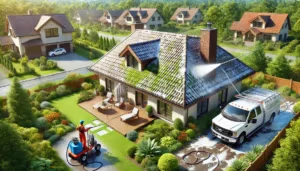
If you’ve noticed dark streaks running down your roof, green patches creeping along the ridgeline, or black staining that no amount of rain seems to wash away, you’re not imagining things. Your roof has a biological problem. And if you live in Tallahassee or anywhere in the Florida Panhandle, this isn’t unusual — it’s almost inevitable.
Tallahassee’s climate is a perfect incubator for the organisms that destroy roofing materials. We average over 60 inches of rainfall per year. Humidity regularly sits above 70% from April through October. Our tree canopy — one of the densest of any city in the country — keeps roofs shaded and damp for hours after rain. The result: algae, moss, lichen, and mold colonize roofing surfaces faster here than in almost any other region in the Southeast.
The solution is not pressure washing. It’s soft washing. And understanding the difference could save you thousands of dollars in premature roof replacement.
What’s Actually Growing on Your Roof?
Most homeowners assume the black streaks on their roof are dirt or soot. They’re not. That discoloration is almost always Gloeocapsa magma — a cyanobacteria (blue-green algae) that spreads via airborne spores. It forms a dark protective pigment that shields it from UV rays, which is why it appears black or dark brown even though the organism itself is green.
Left untreated, algae creates a moist layer that invites moss. Moss holds water against your shingles and works its roots into the spaces between granules and asphalt layers. Over time this causes shingle lifting, cracking, and accelerated granule loss. After moss comes lichen — a hybrid of algae and fungus that bonds directly to roofing surfaces with root-like structures called rhizines. Lichen is extremely difficult to remove and causes surface-level damage that’s visible even after it’s killed.
In Tallahassee’s climate, a roof that’s been allowed to go 3–5 years without treatment can lose 5–10 years of functional lifespan. Most roofing warranties actually include clauses about biological growth — some manufacturers void the warranty entirely if biological staining isn’t addressed within a specific timeframe.
Why Pressure Washing Your Roof Is a Bad Idea
This is where a lot of homeowners (and unfortunately some less reputable contractors) go wrong. A pressure washer at even 1,500–2,000 PSI will absolutely strip algae and moss off your shingles — but it also strips the granules. Those granules are the primary UV shield for asphalt shingles. Once they’re blasted off, the asphalt underneath is exposed to direct sunlight, and the shingle’s lifespan drops dramatically.
High-pressure water can also force itself up under shingles, dislodging them from their sealing strip and creating entry points for water intrusion. It can drive moisture into the decking below, creating conditions for rot and mold growth you can’t see from the outside. One aggressive pressure wash can do enough invisible damage to take years off your roof’s life while making it look clean on the surface.
Reputable roofing manufacturers like GAF and Owens Corning explicitly recommend against high-pressure washing. The Asphalt Roofing Manufacturers Association (ARMA) recommends low-pressure chemical cleaning — which is exactly what soft washing is.
What Is Soft Washing, and How Does It Work?
Soft washing applies a biodegradable cleaning solution to your roof surface at low pressure — typically 40–80 PSI, compared to 1,500–3,000 PSI for a standard pressure washer. The pressure is gentle enough that it wouldn’t even bruise a piece of fruit. The cleaning is done by chemistry, not force.
The cleaning solution is typically a sodium hypochlorite (bleach) base diluted to appropriate concentrations — usually 1–3% for shingles — combined with a surfactant that helps the solution cling to vertical and angled surfaces long enough to work. The sodium hypochlorite kills algae, moss, lichen, mold, and mildew at the cellular level. The surfactant ensures the solution penetrates through the biofilm layer rather than running off the surface.
After a dwell time of 10–20 minutes (depending on the severity of growth), the solution is rinsed with a low-pressure water stream. Dead algae and moss release from the surface and wash away. Lichen takes longer — sometimes requiring a second treatment — but the organism is killed on contact and continues to release over the following weeks with natural rainfall.
Critically, a properly applied soft wash solution doesn’t just clean your roof — it provides residual protection. The treated surface resists new biological growth for 2–4 years in most cases. In Tallahassee’s aggressive climate, we typically recommend scheduling a maintenance treatment every 2–3 years rather than waiting for visible buildup to return.
What Types of Roofs Can Be Soft Washed?
Virtually every residential roofing material is a candidate for soft washing, though the solution concentration and technique vary by material.
Asphalt shingles are the most common roofing material in Tallahassee and benefit the most directly from soft washing. The low pressure protects granules while the solution eliminates biological growth that would otherwise degrade the shingle’s UV protection. Metal roofs — standing seam and corrugated panels — are common in Florida and respond well to soft washing; the solution is effective against the oxidation and biological staining that affects painted and coated metal surfaces. Tile roofs, both clay and concrete, are also frequently soft washed. The porous surface of concrete tile is especially prone to algae and moss growth, and soft washing is the industry standard for tile cleaning.
The one roof type that requires special consideration is cedar shake or wood shingle roofing. Wood requires a lower concentration sodium hypochlorite solution and immediate thorough rinsing to prevent fiber damage. It’s doable, but requires a technician experienced with wood roofing specifically.
What About My Landscaping?
This is the most common concern homeowners raise, and it’s a legitimate one. Sodium hypochlorite is effective precisely because it’s chemically active — which means it can affect plants if it contacts them at high concentrations.
Professional soft washing technicians take multiple steps to protect landscaping. Plants and shrubs near the foundation are pre-wetted before the roof treatment begins — saturating them with water so they’re less absorbent. Tarps are placed over particularly sensitive plantings. Runoff paths are monitored and neutralized as needed after rinsing. The diluted solution used for roof applications — at 1–3% sodium hypochlorite — is far less damaging than the 6% straight bleach some DIYers mix themselves, and professional technicians are trained to manage overspray and runoff systematically.
In our experience working on homes throughout Killearn Estates, Betton Hills, Midtown Tallahassee, and Bradfordville — where mature oak canopy is everywhere — careful plant protection is a standard part of every roof wash job. We’ve never had a landscape damage claim.
Signs Your Roof Needs Soft Washing Now
Not every roof needs cleaning on a set schedule. Here’s what to look for from the ground or from photos taken with a drone or long lens:
- Dark streaking or staining running down the slope of shingles (algae)
- Green or brown fuzzy patches, particularly on north-facing slopes or shaded areas (moss)
- Gray or white crusty patches that don’t wash off with rain (lichen)
- Visible shingle curling or lifting at edges (often caused by moisture from biological growth)
- Black granule accumulation in gutters combined with discoloration on shingles (granule loss accelerated by growth)
- A roof that’s 5+ years old and has never been cleaned, particularly in a wooded setting
In Tallahassee, roofs in heavily treed neighborhoods like Waverly Hills, Ox Bottom, and areas along the Miccosukee Road corridor are particularly susceptible because of the combination of shade, humidity, and leaf debris that stays wet for days. If your neighbors’ roofs look dark and streaked, yours is next if it isn’t already.
How Long Does a Soft Wash Last?
This depends on several factors: the severity of the original growth, the type of roofing material, the amount of shade on the roof, and local climate. For a Tallahassee home with moderate tree coverage and asphalt shingles, a professional soft wash typically produces results that last 2–3 years before retreatment is needed. Homes on open lots with good sun exposure can go 3–4 years. Heavily shaded roofs in areas like Killearn Lakes or the Southwood neighborhood — where mature trees create near-constant shade — may see some regrowth in 18–24 months.
The residual biocide effect of the sodium hypochlorite solution is the key factor. Properly applied, it continues suppressing spore germination long after the rinse. Some contractors apply a post-treatment zinc or copper sulfate solution to further extend the protection period — a service worth asking about if your roof is in a particularly shade-heavy location.
Professional Roof Soft Washing in Tallahassee
Around The Bend Pressure Washing provides professional roof soft washing service throughout the Tallahassee metro area, including Crawfordville, Midway, Quincy, Havana, Woodville, and Wakulla County. We use commercial-grade soft wash systems designed specifically for roof applications — low-pressure delivery with adjustable solution concentration matched to your specific roof type and condition.
We don’t sub out our work or send untrained day labor to your property. Every technician who gets on a roof or operates a soft wash system has been trained on solution chemistry, surface-specific application, and plant protection protocols. We’re fully insured for roof work in Florida, which matters — roof-related insurance claims are something you want your contractor to carry, not you.
If your Tallahassee home’s roof is showing signs of algae, moss, or lichen growth — or if it’s been more than two years since the last cleaning — give us a call. We’ll do a quick assessment, give you an honest quote, and schedule a treatment at your convenience. Call us at 850-888-2105 or reach out through our website to set up an appointment.