How Pressure Washing Prevents Mold and Mildew on Tallahassee Home Exteriors
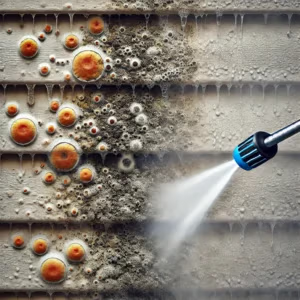
Mold and mildew on exterior surfaces aren’t just aesthetic problems — they’re biological processes that, left unchecked, degrade the surfaces they inhabit and can affect air quality near entryways and HVAC intakes. In Tallahassee’s subtropical climate, where humidity rarely drops below 60% and rainfall exceeds 60 inches annually, exterior mold and mildew growth isn’t a question of whether but when. Understanding how professional pressure washing and soft washing disrupt the mold and mildew cycle — and why mechanical cleaning alone isn’t enough — helps homeowners make better decisions about their maintenance schedules and cleaning methods.
What’s Actually Growing on Your Exterior
The dark streaks, green patches, and gray fuzzy growth on Tallahassee home exteriors fall into a few distinct biological categories, each requiring slightly different treatment approaches:
Algae — The green streaking on north-facing walls, stucco, and siding is primarily chlorophyll-based algae that establishes wherever moisture and shade coexist. In Tallahassee, that’s most of the north and west elevations of any home with significant tree cover. Algae is relatively surface-level and responds well to soft wash treatment.
Mildew — A surface-dwelling fungus that appears as gray or black spotting, typically in sheltered areas: under eave overhangs, on covered porches, and in areas with poor airflow. Mildew is commonly confused with mold but is surface-level rather than penetrating into the substrate.
Gloeocapsa magma — The black streaking on asphalt shingle roofs is actually a cyanobacterium (blue-green algae) rather than mold or mildew. It feeds on limestone granule filler in shingles and spreads by airborne spore transfer. Homes in Killearn Estates, Betton Hills, and Bradfordville under heavy oak canopy see this growth establish quickly on north-facing roof pitches.
Lichen — The gray, crusty, flat growth on brick, stucco, and concrete is lichen — a symbiotic organism combining fungus and algae. It attaches firmly to masonry surfaces and is the most stubborn of the common exterior biological growths to treat. Lichen can take weeks after treatment to fully die and release from the surface.
Why Pressure Washing Alone Doesn’t Prevent Regrowth
This is the most important concept for Tallahassee homeowners to understand about exterior mold and mildew control: mechanical pressure alone removes the visible growth but doesn’t kill it. Scraping mildew off a stucco wall with a pressure washer wand removes what you can see. The hyphae (root structures) and spore mass embedded in the substrate’s pores remain intact. In Tallahassee’s humidity, visible regrowth can reappear within 4–8 weeks on the same surfaces.
This is the functional difference between pressure washing and soft washing for biological growth. Soft wash applies sodium hypochlorite solution at 0.5–1.5% concentration (for house washing) at low pressure with a surfactant that promotes surface contact. The hypochlorite kills the biological organism at the cellular level — not just the surface growth but the root system within the substrate. Killed growth doesn’t regenerate. The surface stays clean significantly longer — 12–18 months in typical Tallahassee conditions versus 4–8 weeks for pressure-only removal.
The Role of Pre-Treatment Chemistry
Professional soft wash applications use a downstream injector to introduce concentrated sodium hypochlorite into the water stream at the low-pressure side of the pump, producing a 0.5–2.0% SH solution at the nozzle depending on injector ratio and tank concentration. This solution is applied through a black soap tip (65° angle, minimal pressure) in broad, overlapping passes across the wall surface.
The surfactant in the solution does two things: it reduces the surface tension of water to improve penetration into the substrate’s pores, and it adds cling to keep the solution in contact with vertical surfaces during the 10–20 minute dwell time required for full biological kill. Without surfactant, a sodium hypochlorite solution applied to a vertical stucco wall runs off before adequate dwell time is achieved — particularly on the steep pitches of Florida-style homes.
After dwell time, the surface is rinsed with a 40° white tip at moderate pressure (800–1,500 PSI depending on surface type). The rinse removes the killed biological matter and the chemical residue, leaving a clean surface. For concrete and hardscape surfaces, the pressure washing pass follows the chemical application to provide mechanical removal of embedded staining that chemistry alone loosens but doesn’t fully lift.
Residual Protection: Extending the Clean Period
Some professional crews apply a post-treatment biocide rinse after pressure washing concrete and hardscape — typically a diluted sodium hypochlorite solution at 0.5–1.0% applied as a final rinse that’s not rinsed off. This residual treatment leaves a biocide film on the surface that slows biological recolonization in the weeks following cleaning. It’s not a permanent barrier — Tallahassee’s rainfall dilutes it gradually — but it meaningfully extends the period before visible algae growth returns on driveways and pool decks, often doubling the interval between cleanings.
For roofs, the sodium hypochlorite applied during soft wash treatment leaves a residual that suppresses Gloeocapsa magma spore germination for months after application. Professional roof treatments in North Florida regularly hold 3–5 years before visible re-streaking occurs when applied at appropriate concentration with adequate dwell time.
Surface-Specific Mold and Mildew Prevention
Stucco and Painted Surfaces
Stucco is particularly susceptible to mold and mildew in Tallahassee because its textured surface creates microscopic pores that retain moisture and provide anchoring sites for biological growth. Homes in Midtown, Waverly Hills, and Southwood with smooth or lightly textured stucco on north and west elevations typically develop visible algae streaking within 6–12 months of the last cleaning. Semi-annual soft wash treatment is the most effective maintenance schedule for high-biological-growth-rate stucco homes.
Concrete Block and Brick
Masonry surfaces — concrete block, brick, and concrete — have high porosity and absorb moisture readily, creating favorable conditions for lichen and mildew establishment. The grout and mortar joints are particularly susceptible. Lichen on masonry requires higher SH concentrations (1.5–2.0%) than algae on painted surfaces, and may require 2–4 weeks of post-treatment time before the full kill result is visible as the killed lichen bleaches and weathers off.
Wood Surfaces
Mildew on wood decks and fences in Tallahassee is nearly universal on surfaces that haven’t been cleaned in 12+ months. Annual cleaning and reapplication of a quality penetrating deck stain with mildewcide compounds significantly reduces mildew establishment compared to untreated or sealed-only wood. The cleaning step — using oxygen bleach or diluted SH to kill biological growth before restaining — is as important as the stain itself for preventing rapid mildew recurrence.
Consistent Maintenance: The Long-Term Strategy
The most effective approach to exterior mold and mildew control in Tallahassee isn’t a single aggressive cleaning — it’s a consistent maintenance schedule that prevents biological growth from establishing deeply before it’s addressed. Surfaces maintained on a regular soft wash schedule never develop the heavy lichen and deep-rooted algae colonies that require multiple aggressive treatments to reverse. The biology is predictable; the maintenance response should be equally predictable.
Around the Bend Pressure Washing serves Tallahassee, Bradfordville, Killearn Estates, Killearn Lakes, Southwood, Midtown, Waverly Hills, Ox Bottom, Crawfordville, Woodville, Quincy, and Midway. Call 850-888-2105 to schedule exterior mold and mildew treatment or to set up a maintenance cleaning plan for your property. We’ll assess what’s growing on your surfaces and recommend the right chemistry, concentration, and schedule to keep it under control.
9 thoughts on “How Pressure Washing Prevents Mold and Mildew on Tallahassee Home Exteriors”
Pingback: Expert Guide: How to Effectively Pressure Wash Different Surfaces for Every Material - Tallahassee Pressure Washing Services
Pingback: Soft Washing vs. Power Washing - What's the Difference and When to Use Them - Tallahassee Pressure Washing Services
Pingback: Sparkling Results: HOA and Multi-Unit Property Cleaning – Why Regular Pressure Washing is Essential - Tallahassee Pressure Washing Services
Pingback: Ultimate Metal Roof Cleaning: How to Maintain and Protect Your Metal Roof - Tallahassee Pressure Washing Services
Pingback: Solar Panel Cleaning: The Ultimate Guide to Keeping Your Panels Pristine - Tallahassee Pressure Washing Services
Pingback: How to Pressure Wash Your Home Like a Pro: Ultimate Guide for Homeowners - Tallahassee Pressure Washing Services
Pingback: The Benefits of Regular Pressure Washing for Your Home - Tallahassee Pressure Washing Services
Pingback: Tipping Etiquette for Pressure Washing Services in Tallahassee - Tallahassee Pressure Washing Services
Pingback: PRESSURE WASHING SERVICES IN TALLAHASSEE TO GET YOUR HOME SPARKLING CLEAN TODAY - Tallahassee Pressure Washing Services