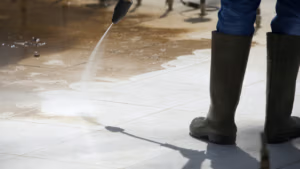
Concrete is the most pressure-washer-friendly surface you’ll encounter on a residential property — but that doesn’t mean any PSI setting is appropriate for any concrete situation. The right pressure depends on the concrete’s age and condition, what you’re trying to remove, and the tools you’re using alongside the pressure washer. Getting it right means cleaner results with less effort and no surface damage.
Standard Concrete: 2,500–3,000 PSI
For poured concrete in good condition — a typical residential driveway, walkway, or patio slab — 2,500–3,000 PSI is the effective working range. At this pressure, you can remove embedded dirt, oxidation, biological growth (algae, mold, mildew), light oil staining, and surface grime without damaging sound concrete.
Normal residential concrete is mixed to 3,500–4,500 PSI compressive strength. A 3,000 PSI pressure washer is well below the surface damage threshold for structurally sound concrete in good repair. The surface aggregate — sand and gravel particles — is held in place by the hardened cement matrix, and standard pressure washing doesn’t disturb this bond when applied with reasonable standoff distance (typically 6–12 inches for a 25-degree nozzle).
Aged or Deteriorated Concrete: 1,500–2,000 PSI
Concrete that has been through years of freeze-thaw cycles, sun exposure, or chemical exposure has a compromised surface layer. In Tallahassee, the main aging factor is sustained UV exposure and ground movement from our clay soil — the Leon County red clay expands and contracts with moisture, creating subtle ground movement that causes surface spalling, scaling, and hairline cracking over time.
Concrete showing spalling (flaking surface layer), scaling (thin layer separation), or significant cracking should be treated at 1,500–2,000 PSI maximum. High-pressure water can widen cracks, accelerate scaling, and dislodge weakly bonded aggregate from the surface layer. When you can see loose material or the surface has a rough, pitted texture from weathering, that’s a signal to reduce pressure and rely more on pre-treatment chemistry to do the cleaning work.
Concrete Pavers: 1,500–2,500 PSI (With Caution on Joints)
Pavers themselves are typically dense, high-strength concrete or clay and can handle pressure washing well. The vulnerability is in the joints. Polymeric sand — the hardened jointing compound used in professional paver installations — handles moderate pressure without issue, but standard sand joints erode quickly under high pressure directed into the joint at close range.
The technique for paver cleaning is to work across the paver surface — not into the joints — at 2,000–2,500 PSI for sealed pavers and 1,500–2,000 PSI for unsealed pavers. A 25-degree nozzle at 12–18 inch standoff distance is the standard approach. If you see sand kicking out of joints, back off the pressure or increase standoff distance immediately. Displaced joint sand should be replaced promptly and the pavers re-sealed; exposed joints allow weed germination, ant infestation, and paver shifting.
Heavily Stained Concrete: Chemistry + Pressure, Not Just More PSI
A common mistake when concrete doesn’t clean up easily is to increase PSI. For most staining types, more pressure isn’t the answer — the right pre-treatment chemistry is. Different stains require different chemical approaches, and getting this right dramatically improves cleaning results at the same or lower pressure.
Oil and grease stains require a degreaser — alkaline cleaners that break the petroleum-to-concrete bond. Apply the degreaser, scrub it in with a stiff brush, let it dwell 10–15 minutes, then pressure wash. This combination removes oil staining that pressure alone cannot. In Tallahassee, motor oil drips on garage aprons and hydraulic fluid staining on commercial concrete are the most common oil-based staining scenarios.
Biological staining — the green algae, black mold, and gray mildew common on Tallahassee concrete — responds to sodium hypochlorite (bleach) pre-treatment. Apply a diluted bleach solution (3–5% concentration for concrete surfaces) before washing, let it dwell, then pressure wash. This approach kills the organisms rather than just displacing them, and the treated surface resists regrowth longer than a purely mechanical clean.
Rust staining from iron deposits or rebar bleed-through requires an oxalic acid or phosphoric acid cleaner — alkaline cleaners and bleach don’t affect rust. Rust staining on concrete is common around steel deck furniture, pool ladders, and metal planters. Acid-based rust removers applied before washing lift most surface rust staining effectively.
Efflorescence — the white chalky mineral deposits that appear on concrete and masonry — also responds to acid cleaning. Muriatic acid diluted 10:1 with water, scrubbed in and thoroughly rinsed, removes efflorescence that pressure washing alone won’t touch.
Surface Cleaner vs. Wand: The Tool Makes a Difference
For cleaning large concrete areas — driveways, patios, parking pads — a surface cleaner attachment is more effective than a pressure wand with a nozzle. A surface cleaner is a disc-shaped attachment with a rotating bar that distributes pressure through two nozzles spinning at high speed inside the housing. This delivers even coverage without the zebra-stripe pattern that single-nozzle wand cleaning creates when overlapping passes aren’t perfectly aligned.
Surface cleaners also reduce operator fatigue on large areas and keep overspray contained — the housing prevents the high-pressure stream from spraying laterally onto cars, landscaping, or siding. For a 500+ square foot driveway, a surface cleaner at 2,500–3,000 PSI cleans more effectively and in less time than wand cleaning at the same PSI.
Professional Concrete Cleaning in Tallahassee
Around The Bend Pressure Washing provides concrete and driveway cleaning throughout Tallahassee, Crawfordville, Midway, Quincy, Bradfordville, and surrounding areas. We use commercial-grade equipment with surface cleaner attachments, pre-treat staining with appropriate chemistry, and match pressure to your specific concrete type and condition. For driveways dealing with Florida clay tracking, algae from summer humidity, or years of accumulated staining, the combination of right chemistry and right pressure makes a significant difference over consumer-grade equipment and technique.
Call us at 850-888-2105 to get a quote on driveway or concrete cleaning at your property.