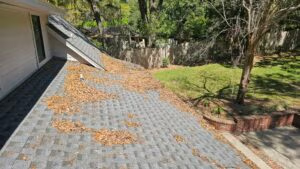
Roof Debris Removal in Tallahassee: Leaves, Pine Needles, and What Happens When They Stay
Tallahassee’s tree canopy is one of its defining features — and one of the most consistent sources of debris accumulation on rooftops in the region. Live oaks, longleaf pines, sweet gums, and magnolias deposit leaves, needles, seed pods, and organic matter onto roof surfaces year-round. Unlike northern climates where leaf fall is a defined autumn event, North Florida’s canopy sheds continuously, meaning organic debris on Tallahassee roofs doesn’t have a season — it has a year-round accumulation rate that varies by tree density rather than time of year.
This guide covers what happens when roof debris is left to accumulate, how to remove it safely without damaging shingles or tile, and when professional soft washing is the right follow-up to debris clearing.
Why Roof Debris Is More Than a Cosmetic Problem
A roof covered in wet leaves and pine needles isn’t just unsightly — it’s actively creating conditions that accelerate roof system deterioration. The problems compound the longer debris sits:
Moisture Retention
Leaves and pine needles hold moisture against the roof surface. On asphalt shingles, persistent moisture creates ideal conditions for Gloeocapsa magma — the cyanobacterium responsible for the black streaking on roofs throughout Tallahassee and North Florida. G. magma feeds on the limestone filler in shingle granules, and its presence is dramatically accelerated by the wet, shaded microclimate that leaf debris creates. What begins as a small streak under a debris pile can expand to full-coverage streaking within one to two wet seasons.
Moss and Lichen Establishment
Organic debris is the perfect seedbed for moss and lichen. Moss spores germinate readily in the moisture retained by leaf and needle accumulations, and established moss colonies attach to shingle granules with root-like structures (rhizoids) that physically lift granules as the moss expands. In Tallahassee neighborhoods like Killearn Estates, Betton Hills, and Bradfordville with heavy overhanging canopy and significant shade on north-facing roof slopes, moss can establish within a single wet season on debris-covered sections of roofing.
Gutter Loading
Roof debris eventually migrates to gutters — either through wind or rain wash. In Tallahassee, where heavy rainfall events can drop 2–4 inches in an afternoon, a debris-laden roof can flood gutters rapidly. Sweet gum balls are particularly problematic at downspout entries, where even a small number create backups that overflow during moderate rain events and direct water against fascia boards and foundation areas. Regular roof debris removal prevents the secondary problem of constant gutter overloading.
Tile Roof Specific: Debris Under Tiles
Tallahassee has a significant number of concrete and clay tile roofs, particularly in newer neighborhoods like Southwood and Killearn Lakes. Pine needles and small debris work their way under tile edges and into the channels between tiles, where they create dams that hold moisture against the underlayment. Debris accumulation under tiles accelerates underlayment degradation — the waterproofing layer that’s the actual defense against water intrusion when tiles crack or displace. Professional debris clearing on tile roofs requires more care than shingle roofs but is equally important.
Safe Debris Removal Techniques
Leaf Blowers: The Standard Tool
A backpack or handheld leaf blower is the standard tool for clearing dry debris from rooftops. It’s fast, effective on loose material, and causes no mechanical contact with the shingle or tile surface. Key technique points: always blow debris off the roof in the direction of slope (down and off the edge), not across the surface or upward against the slope. Blowing upward forces debris under shingle tabs and tile edges. Work from ridge to eave, clearing sections systematically rather than chasing debris across the full roof.
Dry debris blows off easily. Wet, matted debris — leaves compressed by rain and beginning to decompose — doesn’t respond to blowing and requires manual raking or a soft brush. Attempting to blow wet matted debris off a shingle roof often just moves it around without removing it, and aggressive high-CFM blowing at close range on saturated shingles can disturb granules. Wet debris removal is a slower, more careful process than dry leaf clearing.
Roof Rakes: Ground-Level Option for Some Pitches
For lower-pitch roofs (4:12 and under) on single-story Tallahassee homes, a long-handled roof rake allows debris clearing from ground level on accessible areas — no ladder required for those sections. Roof rakes don’t work well on steeper pitches or two-story roofs where reach is insufficient, but for Florida-typical low-slope rooflines on ranch homes in Midtown, Ox Bottom, and Waverly Hills, they’re a useful ground-level tool that reduces ladder risk for homeowners doing their own maintenance.
What Not to Do
High-pressure washing to blast debris off a shingle roof is the approach that causes the most damage. At 2,000+ PSI, water strips the granule coating from asphalt shingles, voids most manufacturer warranties, and reduces shingle life. The Asphalt Roofing Manufacturers Association (ARMA) specifically prohibits high-pressure washing on shingles. Soft wash — the low-pressure chemical application that kills biological growth — is appropriate for roof cleaning; high-pressure washing is not.
Wire brushes and metal-tipped tools on shingles also damage granule coating and should never be used. Stiff-bristle plastic brushes are acceptable for specific spot cleaning but should be used with very light pressure on shingles.
After Debris Removal: When to Soft Wash
Removing physical debris doesn’t address the biological growth that debris accumulation enables. After clearing leaves and pine needles from a roof that has shown algae streaking, moss establishment, or lichen growth, a professional soft wash treatment is the logical follow-up step. The soft wash applies a sodium hypochlorite solution at 2–4% concentration (appropriate to the severity of biological growth) at 60–100 PSI — low enough to cause no shingle damage — with adequate dwell time before rinsing.
This kills the biological growth at the root rather than just the visible surface expression. On Tallahassee roofs where G. magma and moss have established under persistent debris cover, soft wash treatment after debris removal produces results that last 3–5 years in North Florida conditions, compared to the rapid re-establishment that occurs if only the physical debris is removed and the biological colonization is left in place.
Frequency: How Often to Clear Roof Debris in North Florida
Homes with light to moderate tree canopy in Tallahassee — a few trees nearby but not directly overhanging the roof — typically benefit from roof debris clearing once or twice per year: spring after the heaviest pollen and seed pod drop, and fall after the peak of sweet gum and deciduous leaf fall. Homes with significant direct overhead canopy in neighborhoods like Killearn Estates, Bradfordville, and Betton Hills may need quarterly debris checks, particularly in the summer wet season when heavy rain events wash debris from branches onto rooftops rapidly.
The practical check: if you can see debris accumulation from ground level — patches of leaves or needles on the visible roof sections — it’s time to clear. Debris that’s been on the roof long enough to start visible decomposition (darkened, compressed mats rather than recognizable whole leaves) has been there too long and should be prioritized for clearing and biological treatment.
Professional Roof Maintenance for Tallahassee Homes
Around the Bend Pressure Washing handles roof debris clearing, soft wash roof treatment, and gutter cleaning as part of complete roof maintenance service for Tallahassee and surrounding areas. We serve Bradfordville, Killearn Estates, Killearn Lakes, Southwood, Midtown, Waverly Hills, Ox Bottom, Crawfordville, Woodville, Quincy, and Midway.
If your roof has visible debris accumulation, algae streaking, or moss growth — or if you simply want to get ahead of the problem before it creates biological colonization — call 850-888-2105 to schedule. We’ll assess the roof condition and recommend the appropriate combination of debris clearing and soft wash treatment for your specific roof type and canopy situation.