Two of the most searched terms in the exterior cleaning industry are “pressure washing” and “soft washing,” and the confusion between them is understandable. Both involve water. Both clean exterior surfaces. Both are offered by the same contractors in most markets. But they work through fundamentally different mechanisms, require different equipment, and produce different outcomes depending on what you’re cleaning.
For Tallahassee homeowners navigating Florida’s specific combination of heat, humidity, biological growth, and diverse exterior surface materials, understanding these differences isn’t just academic — it directly affects whether your surfaces get cleaned safely, how long the results last, and whether you inadvertently cause damage that costs more than the cleaning itself.
The Core Difference: Force vs. Chemistry
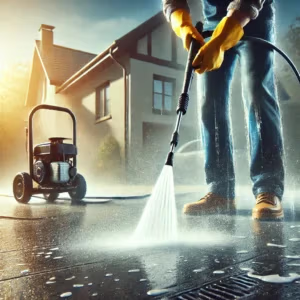
Pressure washing removes contaminants through mechanical force. A high-pressure stream of water moving at 1,500–3,000+ PSI physically blasts dirt, organic growth, and debris off the surface. The water stream doesn’t care whether the contamination is biological or mineral — it’s being dislodged by impact energy.
Soft washing removes contaminants through chemistry. A cleaning solution — typically a sodium hypochlorite (bleach) base at 1–3% concentration combined with a surfactant — is applied to the surface at 40–80 PSI, which is barely above garden hose pressure. The solution dwells on the surface for 10–20 minutes, killing biological organisms at the cellular level. The low-pressure rinse afterward removes dead organic matter and residual solution. The pressure isn’t cleaning anything — the chemistry is.
This distinction explains why the two methods produce different outcomes and why neither is universally “better.” They’re tools for different jobs.
Equipment Differences
A pressure washer is a motorized pump that takes water from a supply line and pressurizes it before forcing it through a nozzle. The nozzle determines how that pressure is applied — from a zero-degree cutting stream to a wide-angle fan that disperses the force over a larger area. Consumer pressure washers run 1,500–2,000 PSI; professional commercial units often run 3,000–4,000 PSI with higher flow rates (measured in gallons per minute, or GPM) that matter as much as PSI for efficient cleaning of large surfaces.
A soft wash system is a separate category of equipment. It requires a chemical-resistant tank and pump system that can draw cleaning solution from a tank and mix it to precise concentrations before delivery. Some systems batch-mix solution; others inject chemical inline with water flow at adjustable ratios. The delivery pressure stays in the 40–80 PSI range, which a standard pressure washer with a soap nozzle can approximate but not fully replicate — consumer pressure washers with downstream injection often dilute the chemical too much to achieve the dwell concentrations needed for effective soft washing.
This equipment distinction is why DIY soft washing often underperforms professional soft washing even when homeowners attempt it with consumer equipment. The chemistry needs to be right — concentration, dwell time, surfactant ratio — and consumer equipment often can’t deliver the solution consistently enough.
How Results Differ
The results differ in two important ways: immediate appearance and durability of the clean.
For surfaces with biological contamination — the green haze on your vinyl siding, the black streaks on your roof, the gray-green film on your pool cage — pressure washing produces an immediate visual improvement but doesn’t address the underlying biology. Algae spores, mold mycelium, and lichen rhizines remain on or slightly below the surface after the visible growth is removed. In Tallahassee’s warm, humid climate, visible regrowth typically reappears within 2–4 months.
Soft washing kills the organism. The surface is clean because the biology is dead, not just displaced. The residual biocide effect of the sodium hypochlorite solution continues suppressing new spore germination for months after treatment. In practice, a professionally soft-washed exterior surface in Tallahassee stays visibly clean for 12–18 months in most cases — three to five times longer than a pressure-washed surface with the same initial contamination.
For non-biological contamination — oil stains on concrete, mineral deposits on brick, rust staining on pavers — the dynamic reverses. Chemistry alone won’t lift an oil stain from concrete; it needs mechanical force to break the bond between the oil and the concrete pores. Here, pressure washing is more effective, and soft washing adds little value beyond what a low-pressure pre-treatment might accomplish.
Surface Damage Risk
Pressure washing carries a real and underappreciated damage risk when misapplied. The force that makes it effective on concrete can destroy more delicate surfaces. Specific damage mechanisms to be aware of:
On asphalt shingles, high-pressure water strips the ceramic granules bonded to the shingle surface. These granules are the shingle’s primary UV shield — lose enough of them and the asphalt degrades rapidly. A single high-pressure roof wash can reduce a roof’s remaining lifespan by several years while making it look temporarily clean.
On wood siding, pressure high enough to remove mildew is also high enough to raise the wood grain, splinter surface fibers, and drive water into the wood beyond what it can drain. Repeated aggressive washing of wood siding accelerates checking (surface cracking), paint adhesion failure, and moisture damage to the substrate.
On stucco — common in older Tallahassee neighborhoods like Betton Hills, Midtown, and Myers Park — high pressure impacts crack hairline fractures and force water into the wall cavity behind the stucco layer. Water intrusion in stucco walls is one of the most expensive repair scenarios a homeowner can face: full stucco replacement plus interior drywall remediation if the moisture reaches the framing.
On window and door caulking, high-pressure streams directed at frame joints blow out the watertight seal, creating immediate water intrusion pathways that aren’t visible from the outside until the damage shows up as interior moisture, mold, or paint bubbling months later.
Soft washing carries virtually none of these damage risks on the same surfaces. The 40–80 PSI delivery pressure is below the threshold of any surface damage concern for standard residential exterior materials. The risk from soft washing is primarily chemical — overspray or runoff reaching sensitive landscaping or glass surfaces — and these are managed through pre-wetting plants, protecting glass, and controlling rinse paths.
Side-by-Side: Which Method for Which Surface?
Driveways and concrete walkways: pressure washing. The surface can handle high PSI, the contamination (oil, tire marks, heavy grime) benefits from mechanical force, and a surface cleaner attachment distributes pressure evenly for streak-free results.
Roofs (all types): soft washing only. No high-pressure water should contact residential roofing materials. Period.
House siding (vinyl, stucco, painted wood, fiber cement): soft washing for biological contamination, which is the typical case in Tallahassee. Low-pressure pressure washing (under 1,200 PSI with wide-angle nozzle) is acceptable for vinyl in good condition with non-biological staining.
Wood decks and fences: low-pressure washing or soft washing. Maximum 800 PSI, 40-degree nozzle, with-the-grain passes. Pre-treatment chemical application is often more effective than pressure alone.
Pool cages and screen enclosures: soft washing only. Aluminum frames and fiberglass screen can’t tolerate high pressure without bending or tearing.
Brick and stone hardscape: pressure washing at 1,500–2,000 PSI for hard, well-set materials. Reduce pressure for aged brick, deteriorating mortar, or stone with a soft or porous composition.
Professional Exterior Cleaning in Tallahassee
Around The Bend Pressure Washing handles both pressure washing and soft washing throughout the Tallahassee area — including Leon County, Gadsden County, Wakulla County, and communities like Crawfordville, Midway, Quincy, Bradfordville, Killearn Estates, Southwood, and Betton Hills.
We approach every job by assessing the surface material, the type of contamination, and what outcome you need — then selecting the appropriate method and equipment. If you’re unsure what your property needs, we’re happy to walk through it with you. Call us at 850-888-2105 or reach out through our website to schedule an assessment or get a quote.
5 thoughts on “Pressure Washing vs. Soft Washing: Understanding the Differences and Choosing the Right Method”
Pingback: Pressure Washer Maintenance and Troubleshooting: The Ultimate Guide to Keep Your Equipment Running Smoothly - Tallahassee Pressure Washing Services
Pingback: Why Soft Wash House Cleaning is the Best Choice for Your Home - Tallahassee Pressure Washing Services
Pingback: The Environmental Impact of Pressure Washing: What You Should Know - Tallahassee Pressure Washing Services
Pingback: Roof Cleaning 101: The Benefits of Soft Washing Your Roof - Tallahassee Pressure Washing Services
Pingback: Ultimate Guide: Must-Have Pressure Washer Accessories for a Perfect Clean - Tallahassee Pressure Washing Services