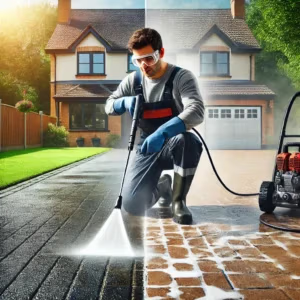
Debunking Common Pressure Washing Myths: What’s Actually True
Pressure washing is one of those services surrounded by a surprising amount of bad information — myths repeated by homeowners, contractors who should know better, and online guides that haven’t been updated since someone’s uncle bought a hardware store machine. In Tallahassee’s market, where the wrong approach causes real surface damage and the right approach produces results that last years, separating fact from fiction matters. Here are the most common pressure washing myths we encounter — and the truth behind each one.
Myth 1: “More PSI Always Means Better Cleaning”
Reality: PSI is one of two key performance variables, and alone it’s an incomplete measure. The real indicator of cleaning power is cleaning units: PSI multiplied by GPM (gallons per minute). A machine at 3,500 PSI with 4.0 GPM delivers 14,000 cleaning units. A machine at 4,500 PSI with 1.5 GPM delivers only 6,750. The higher-PSI machine in this comparison is actually less effective for large-area concrete work.
More importantly, excess PSI on the wrong surface causes damage that lower PSI prevents. On wood decks, the right PSI is 1,200–1,800. On stucco, 1,000–1,500. On brick with older mortar, 1,500–2,000 with careful technique. Applying concrete PSI (3,000–4,000) to these surfaces strips paint, raises wood grain, erodes mortar, and forces water into wall cavities. The right PSI for the surface — not the maximum available — is what produces clean results without damage.