The Real Cons of Pressure Washing (And When They Actually Apply)
Pressure washing is one of the most effective exterior cleaning methods available — but it’s not right for every surface, every situation, or every operator. The honest answer to “what are the cons of pressure washing?” depends heavily on what’s being cleaned, what PSI is being used, and who’s behind the wand. This post covers the real limitations and risks of pressure washing so Tallahassee homeowners can make informed decisions about when to use it, when to use a different method, and when to hire a professional rather than renting a machine.
Surface Damage: The Most Common Risk
The most significant con of pressure washing is also the most preventable: wrong PSI or wrong nozzle on the wrong surface. Pressure washing concrete at 3,500 PSI with a green 25° tip is completely appropriate. Applying that same setup to wood siding, painted stucco, or an asphalt shingle roof causes serious damage.
On asphalt shingle roofs, high-pressure washing strips granules — the protective surface layer embedded in shingle material. Granule loss shortens shingle life and accelerates UV degradation. GAF, Owens Corning, and CertainTeed all specifically prohibit high-pressure washing on their shingle products. The correct method for roof cleaning is soft washing: a sodium hypochlorite solution at 2–4% concentration applied at 60–100 PSI, with adequate dwell time before a low-pressure rinse.
On wood — decks, fences, siding — excess pressure raises the wood grain, creating a rough, fuzzy surface texture that’s harder to stain evenly and more susceptible to future moisture penetration. It can also drive water into end grain sections and through siding into wall cavities. The fix is correct PSI (1,000–1,800 PSI depending on species) with a 40° white tip rather than a 15° or 25° tip.
On mortar joints between brick, aggressive pressure at close standoff distance can erode the mortar, particularly on older Tallahassee homes where mortar has softened with age. Damaged mortar needs repointing — a repair that costs more than the cleaning would have. The solution is working at 1,500–2,000 PSI on brick, maintaining standoff distance, and never using a surface cleaner on mortar joints.
Water Intrusion
High-pressure water can force its way into gaps, cracks, and overlapping surfaces that would otherwise exclude rain. Horizontal lap siding is the most common example: water sprayed at an upward angle forces past the lap joint and into the wall cavity, depositing moisture where it can’t dry, leading to mold, rot, and structural damage over time.
Professional operators avoid this by working downward with the water flow on siding, never shooting water upward at lap joints or window frames. They also avoid directing high-pressure spray at window seals, door thresholds, electrical outlets, and HVAC penetrations where water intrusion is possible. In Tallahassee’s humid climate, any moisture that gets into a wall cavity and can’t dry will feed mold growth aggressively — which is why technique matters so much on house washing.
Paint and Coating Damage
Pressure washing will strip paint — that’s actually an intentional feature when prepping surfaces for repainting. The con is when it strips paint unintentionally, on surfaces the homeowner didn’t intend to repaint. Older paint in poor condition, painted brick with peeling finish, painted wood trim that’s been weathering for years — these surfaces can lose their coating under moderate pressure washing that wouldn’t touch well-adhered, properly applied paint.
For Tallahassee homeowners, the practical implication: if your painted exterior surfaces have visible peeling, cracking, or adhesion failure, pressure washing will accelerate the loss of that paint. This isn’t necessarily bad if repainting is the plan, but it’s worth knowing before the job starts. A professional assessment before house washing identifies paint condition so there are no surprises about what the surface looks like after the cleaning.
High Water Consumption
Professional gas pressure washers run at 3.5–5.0 GPM — gallons per minute. A four-hour driveway and house washing job uses 840–1,200 gallons of water. For homeowners on municipal water in Tallahassee, this shows up on the water bill. It’s not an enormous amount — a typical Tallahassee household uses more than this monthly — but it’s worth noting if water costs are a concern or if a property is on well water with limited capacity.
Water use is inherent to the process and can’t be reduced significantly without reducing effectiveness. Soft wash applications use less water than pressure washing because the low-pressure pump delivers lower volume, but the tradeoff is that rinse volume still needs to be adequate to remove cleaning chemicals from treated surfaces. This is not a reason to avoid professional cleaning — just something to factor in.
Temporary Disruption and Runoff
Pressure washing generates significant runoff and overspray that temporarily affects the work area and immediate surroundings. Concrete cleaning removes embedded material that runs off as brown or gray water. Soft wash applications produce chemical-carrying runoff that should be directed away from storm drains and water features when possible. Overspray from house washing can reach neighboring properties and parked vehicles.
Professional crews in Tallahassee manage runoff by pre-wetting adjacent landscaping, directing runoff toward grassed areas rather than storm drains when possible, and using reasonable chemical concentrations that dilute rapidly upon rinsing. For homeowners with fish ponds, rain barrels, or ornamental water features near the work area, flagging these to the crew before the job starts allows them to direct runoff and rinse water appropriately.
Injury Risk for DIY Operators
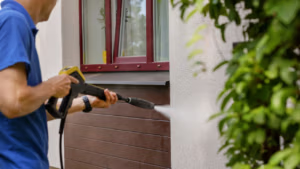
A commercial gas pressure washer at 3,500 PSI can lacerate skin at close range and inject water and bacteria into tissue — a medical emergency requiring immediate treatment. This isn’t a rare hypothetical: pressure washing injuries send tens of thousands of people to emergency rooms annually, and most involve untrained operators using rented machines. The wand can also kick back unexpectedly when a nozzle is partially blocked, and operating from a ladder while managing a pressurized wand is genuinely dangerous.
DIY pressure washing with proper technique and reasonable PSI is manageable for the right surfaces. But using a surface cleaner on a concrete driveway is very different from trying to clean a two-story gutter line or a sloped roof from a ladder. For anything requiring elevation or a surface where technique errors cause expensive damage, professional service is the risk-appropriate choice.
The Actual Solution to Most Cons
Most of the cons listed above have the same root cause: wrong method, wrong PSI, wrong nozzle, or wrong operator for the surface. Professional pressure washing by an experienced crew eliminates most of these risks. The remaining considerations — water use, temporary disruption, and the need to prepare the property — are inherent to the service and are manageable with simple preparation.
If you’re in Tallahassee, Bradfordville, Killearn Estates, Killearn Lakes, Southwood, Midtown, Waverly Hills, Ox Bottom, Crawfordville, Woodville, Quincy, or Midway and want exterior cleaning done without the risks of DIY technique — the surface damage, water intrusion, and the general uncertainty about whether you’re using the right equipment — call Around the Bend Pressure Washing at 850-888-2105. We’ll tell you exactly what method is appropriate for each surface on your property and give you an honest assessment of what to expect.