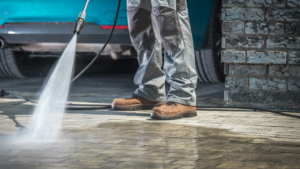
The time it takes to pressure wash a driveway varies more than most people expect — and understanding the variables helps you plan your day if you’re doing it yourself or set realistic expectations when scheduling a professional service. Equipment quality, driveway size, contamination level, and the technique used all affect the timeline significantly.
Typical Timeframes by Driveway Size
For a standard two-car concrete driveway (400–600 square feet) with moderate contamination (biological growth, general staining, no severe oil deposits) using consumer equipment without a surface cleaner, expect 1.5–3 hours including setup and cleanup. With a surface cleaner attachment on quality gas equipment, the same driveway typically takes 45 minutes to 1.5 hours. Professional commercial equipment with a surface cleaner can cover 500 square feet in 20–40 minutes for cleaning time, with total job time (setup, pre-treatment, cleaning, rinse, cleanup) running 45–90 minutes.
Longer driveways — 150-foot runs common on Tallahassee properties with circular driveways or long approaches — scale proportionally. A 1,500 square foot driveway might take a professional 2–3 hours total; DIY with consumer equipment could stretch to a full day on a large property.
What Slows the Job Down
Pre-treatment adds time but produces dramatically better results on stained concrete. Applying a degreaser to oil-stained areas (dwell 15–20 minutes), or a sodium hypochlorite pre-treatment for heavy biological growth (dwell 10–15 minutes), adds that dwell period to the job timeline but allows the washing to go faster and produces a cleaner result than trying to pressure wash the staining away without chemistry. Skipping pre-treatment saves time upfront but leaves the staining partially in place and means faster regrowth of biological contamination.
Heavily contaminated driveways — multiple years of accumulated staining, thick biological growth, deeply embedded grime — require more passes and sometimes repeat treatment. Tallahassee driveways under heavy tree canopy that haven’t been cleaned in 2–3 years often have compacted, dark biological growth in shaded areas that takes more than one cleaning pass to fully address.
Equipment flow rate (GPM) matters more than people realize for time efficiency. A consumer unit at 1.5 GPM and a commercial unit at 4.0 GPM both deliver cleaning force — but the commercial unit also flushes the removed material away from the surface nearly three times faster. On a large concrete area, this difference in rinse efficiency directly translates to job completion time.
Driveway shape and obstacles add time. Straight rectangular driveways are the fastest. Driveways with curves, multiple levels, islands, pavers with joint concerns, or narrow sections adjacent to landscaping all require technique adjustment and slower working speed. Decorative stamped or exposed aggregate concrete needs lower pressure and more careful technique, which slows coverage rate.
Surface Cleaner vs. Wand: The Biggest Time Factor
If there’s one equipment choice that most dramatically affects driveway cleaning time, it’s the surface cleaner attachment. A surface cleaner is a disc-shaped housing with a rotating bar containing two nozzles that spin at high speed, covering a 12–20 inch wide path with each pass. Compared to a wand nozzle that cleans a 4–6 inch wide path per pass, the surface cleaner covers 3–5x more area per pass at the same walking speed. For a 500 square foot driveway, this difference means 10–15 minutes of cleaning time versus 45–60 minutes with a wand.
Surface cleaners also produce more even results — no zebra striping from overlapping wand passes — and keep overspray contained within the housing rather than spraying laterally onto adjacent surfaces. For DIY operators, a $50–$100 surface cleaner attachment is one of the highest-ROI accessories for driveway cleaning.
Drying and Curing Time
Concrete is fully dry for foot traffic within 30–60 minutes in Tallahassee’s summer temperatures. In cooler weather (December–February) when temperatures stay in the 50s–60s, drying takes longer — 1–3 hours for the surface to be dry enough for normal use. For vehicle use, most contractors recommend waiting until the surface is fully dry to avoid tire tracking, typically 30–60 minutes in warm weather.
If you’re sealing concrete or pavers after cleaning, the surface needs to be completely dry — typically 24 hours in warm, low-humidity conditions, longer in Tallahassee’s humid climate. Sealing over concrete with residual moisture causes adhesion failure and cloudiness in the sealer film.
Professional Driveway Cleaning in Tallahassee
Around The Bend Pressure Washing handles driveway and concrete cleaning throughout Tallahassee and the surrounding area. Most residential driveway jobs are completed within 1–2 hours, including pre-treatment and rinse. We use commercial surface cleaner equipment for consistent, streak-free results. Call us at 850-888-2105 to schedule service.