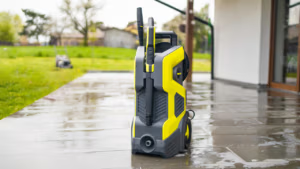
The short answer is yes — but the longer answer matters a lot more. Pressure washing a house is one of the most effective ways to restore curb appeal, remove mold and mildew, and prep exterior surfaces for painting or sealing. Done correctly, it’s safe, efficient, and dramatically extends the life of your siding, trim, and painted surfaces. Done incorrectly, it can drive water behind siding, crack wood, strip paint, damage window seals, and create moisture problems that cost far more to fix than the cleaning would have saved.
For homeowners in Tallahassee, the stakes are a bit higher than in drier climates. Our humidity, heavy seasonal rainfall, and subtropical heat create near-ideal conditions for mold, mildew, and algae growth on exterior surfaces. Most homes here need exterior cleaning more frequently than national averages suggest — and doing it wrong in this climate compounds problems fast.
Here’s what you actually need to know before running a pressure washer across your home’s exterior.
What Types of Siding Can Be Pressure Washed?
Not all exterior surfaces are created equal when it comes to pressure washing tolerance. The material your home is clad in is the single most important factor in determining the appropriate pressure, technique, and whether you should use pressure washing or soft washing.
Vinyl siding is the most forgiving and the most common in Tallahassee subdivisions. It can handle moderate pressure — 1,200–1,500 PSI from a distance of 12–18 inches — without damage. The critical rule with vinyl is to always spray downward or at a horizontal angle, never upward. Spraying upward forces water behind the siding panels where it has nowhere to drain, creating exactly the moisture problem you were trying to clean up. Use a 25-degree (green) or 40-degree (white) nozzle on vinyl.
Wood siding — clapboard, shiplap, hardboard, cedar shake — requires significantly more care. Wood is porous and can absorb large amounts of water if high pressure is applied. Wet wood expands, and repeated wet/dry cycles accelerate cracking, warping, and paint failure. For wood siding, 500–800 PSI maximum is the safe range, and a 40-degree or soap nozzle should be used. Many professionals prefer soft washing for wood siding entirely — applying a cleaning solution at very low pressure and allowing chemistry to do the work rather than mechanical force.
Brick and masonry can handle higher pressure — up to 2,000 PSI for aged, solid brick — but aged or soft brick can be damaged by aggressive washing. The bigger concern with brick is the mortar. Standard cement mortar in good condition is fine, but older or deteriorating mortar joints can be eroded by high-pressure water. Test an inconspicuous section before cleaning the full facade. Efflorescence (white salt deposits) on brick often doesn’t respond to pressure alone and may require chemical treatment.
Stucco is common across Tallahassee’s older homes, particularly in neighborhoods like Betton Hills, Midtown, and the Myers Park area. Stucco is the surface that gets new homeowners in the most trouble with pressure washing. It looks hard, but the surface layer is typically 3/8 to 3/4 inch thick and can crack under high-pressure impact — especially stucco that has developed hairline cracks from Florida’s seasonal expansion and contraction. For stucco, 1,200 PSI and a 40-degree nozzle at a 24-inch distance is the maximum most professionals recommend. Any existing cracks should be repaired before washing.
Fiber cement siding (Hardie board) is increasingly popular in newer Tallahassee construction and handles pressure washing well — similar parameters to vinyl, with the same rule about spraying downward, not upward.
When Should You Soft Wash Instead?
Soft washing is the preferred method for surfaces where high pressure poses a damage risk or where biological growth is the primary issue to address. The technique uses cleaning solution — typically a sodium hypochlorite and surfactant blend — applied at 40–80 PSI, followed by a low-pressure rinse. The chemistry kills the organic matter; the pressure just rinses it off.
For house washing specifically, soft washing is often the better choice when: the home has wood, stucco, or painted siding with any signs of wear; the primary contamination is biological (algae, mildew, mold, lichen); there are painted surfaces where granule or finish damage is a concern; or the homeowner wants a longer-lasting clean since the biocide residual suppresses regrowth for months after treatment.
In Tallahassee’s climate, most of the visual contamination on house exteriors is biological in nature. That green haze on the north-facing wall? Algae. The black streaking under the soffits? Mold. The gray film on vinyl? Mildew. Pressure washing alone removes the visible symptom temporarily — soft washing kills the organism and slows regrowth. For routine annual or biannual house washing in this climate, soft washing is almost always the appropriate method.
What Parts of a House Should Not Be Pressure Washed?
Even when the siding is pressure-wash-safe, certain areas and features of a home’s exterior require special handling or should be avoided entirely.
Window seals and caulking are the most common casualty of DIY pressure washing. The watertight seals around window frames — between the frame and the exterior wall — can be blown out by high pressure, creating immediate water intrusion pathways. If you’re washing near windows, reduce pressure and angle the spray away from the frame joints.
Electrical outlets, exterior light fixtures, and HVAC components should be avoided. Water forced into an electrical housing creates a serious hazard. Exterior outlets in Florida should have weatherproof covers, but they’re not designed for direct high-pressure water impact.
Roof shingles should not be pressure washed under any circumstances. The granules that protect asphalt shingles are loosely bonded to the surface — high pressure strips them, reducing the shingle’s UV protection and dramatically shortening its lifespan. Soft washing is the only appropriate method for roof cleaning.
Painted wood trim, shutters, and decorative millwork should be approached with low pressure and the appropriate detergent. High pressure on aged paint causes peeling and blasting — the paint delaminates and peels away in strips, leaving bare wood exposed to the elements. If the paint is already in poor condition, pressure washing will accelerate failure.
How Often Should Tallahassee Homes Be Pressure Washed?
The standard recommendation is once per year for homes in Florida’s humid climates. In practice, the right frequency depends on your home’s specific conditions: the amount of tree coverage (more shade = faster algae growth), the direction your home faces, the material your siding is made of, and your neighborhood’s typical humidity levels.
Homes in wooded Tallahassee neighborhoods — Killearn Estates, Killearn Lakes, Waverly Hills, the Ox Bottom Road area, and Bradfordville — typically need annual exterior washing because the tree canopy keeps surfaces damp and the organic debris from pollen and leaves creates a nutrient layer that accelerates biological growth. Homes in sunnier, more open subdivisions in Crawfordville or Midway may go 18 months between washings without visible issues.
A simple way to assess timing: if you can see a green or gray haze developing on north-facing walls, if your driveway is starting to discolor, or if the trim around windows is showing black spotting, it’s time. Waiting until the growth is heavy doesn’t save you money — it costs more in cleaning time and creates a higher risk that the biological growth has caused surface damage underneath.
DIY vs. Professional House Washing
Consumer pressure washers in the 1,500–2,000 PSI range are widely available and can handle basic tasks like driveway cleaning effectively. For house washing, the risks of DIY increase significantly. Inexperienced operators commonly hold the nozzle too close to the surface, use too-aggressive nozzle angles, spray upward into siding laps, and apply too much pressure to painted or delicate surfaces. The damage from a botched DIY wash can cost more to repair than a professional cleaning would have cost in the first place.
Professional exterior cleaning companies use commercial equipment that allows precise pressure adjustment — the ability to dial down to 500 PSI or lower for delicate surfaces, and to apply soft wash chemicals at 40–80 PSI for biological contamination. They also understand surface-specific technique, sequencing (clean from top down), and how to protect landscaping and fixtures during cleaning.
Professional House Washing in Tallahassee
Around The Bend Pressure Washing handles exterior house washing for homes throughout the Tallahassee area, including Leon, Gadsden, Wakulla, and Jefferson counties. We assess your siding type and current condition before starting any job and select the appropriate method — pressure washing, soft washing, or a combination — based on what your home actually needs.
We serve homeowners in Killearn Estates, Betton Hills, Southwood, Midtown, Bradfordville, Crawfordville, Quincy, Midway, and Woodville. Whether it’s a routine annual wash to keep the mildew at bay or a pre-sale cleaning to maximize your home’s first impression, we’ll give you a straightforward assessment and a no-surprise quote.
Call us at 850-888-2105 to schedule your exterior house washing service, or reach out through our website. We’re a locally owned and operated business and we stand behind our work.