Does Power Washing Damage Concrete? A Tallahassee Expert’s Honest Answer
It’s one of the most common questions we get from homeowners before scheduling a cleaning: “Will power washing actually damage my concrete?” The concern is legitimate. You’ve got a driveway, patio, or pool deck that represents a real investment, and the idea of a high-pressure water stream hitting it at full force doesn’t always inspire confidence.
The honest answer is: it depends entirely on how it’s done. Power washing can damage concrete — and it can also clean it beautifully without causing any harm whatsoever. The difference comes down to pressure settings, nozzle selection, technique, and whether the person holding the wand actually knows what they’re doing. Let’s break it down.
When Power Washing Does Damage Concrete
Concrete is a porous material, and while it’s extremely durable under compression, it’s vulnerable to surface damage when high-pressure water is applied incorrectly. Here are the specific scenarios where damage occurs:
Too Much Pressure at Too Close a Distance
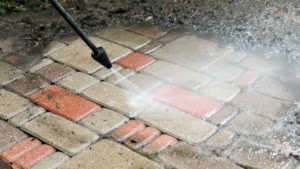
This is the number one cause of DIY power washing damage. A zero-degree (red) nozzle or a narrow-angle nozzle held 4–6 inches from the surface can etch visible lines into concrete — you’ll see this on driveways where the homeowner swept the wand back and forth, leaving a striped pattern that’s now permanent. The surface aggregate gets displaced, leaving a rougher texture that actually traps more dirt going forward.
The rule of thumb for concrete: never use a zero-degree nozzle, and keep any nozzle at least 8–10 inches from the surface. A 25-degree (green) nozzle at 10–12 inches is the safe starting point for most residential concrete.
Washing Already-Compromised Concrete
Concrete that already has cracks, spalling, or surface deterioration is more vulnerable. Directing high-pressure water into an existing crack can introduce water under the slab and — in freeze-thaw climates — cause further expansion. In Tallahassee we don’t have a significant freeze-thaw cycle, but water intrusion under a slab sitting on North Florida’s expansive clay soil can cause settling and heaving. A good professional will inspect for this before washing.
Blasting Off a New Concrete Sealer
If your driveway was recently sealed — within the past year or two — aggressive power washing can strip that sealer, leaving the concrete unprotected. This isn’t damage to the concrete itself, but it’s wasted money. A soft wash approach or lower-pressure cleaning is appropriate for recently sealed surfaces.
Using Hot Water on Certain Decorative Finishes
Stamped concrete, exposed aggregate, and decorative overlays can be more sensitive than standard broom-finished concrete. Hot water at high pressure can soften certain sealers and cause them to cloud or bubble. These surfaces need a lower-pressure, cooler approach — something a professional should know before starting.
When Power Washing is Completely Safe for Concrete
The vast majority of residential concrete driveways, patios, and walkways in Tallahassee can be power washed safely, repeatedly, and with excellent results. Standard broom-finished concrete is quite forgiving when cleaned with appropriate equipment and technique. Here’s what safe, professional concrete cleaning looks like:
- Pressure range: 2,500–3,500 PSI for standard concrete. Higher pressure is sometimes used for commercial applications but isn’t necessary for residential driveways.
- Nozzle: 25-degree (green) for general cleaning, 15-degree (yellow) only for stubborn spot staining held at distance.
- Surface cleaner attachment: The professional standard for driveways. Provides even coverage, eliminates striping, and is safer for the surface than a hand wand at the same pressure.
- Pre-treatment: Applying a degreaser or concrete cleaner before washing does most of the heavy lifting and means less pressure is needed to get the surface clean.
- Consistent distance and movement: Keeping the nozzle at a consistent height and moving at an even pace prevents the uneven etching that causes visible damage.
Done this way, power washing is not damaging to concrete — it’s actually beneficial. Removing organic growth (algae, mold, mildew) stops the slow biological deterioration of the surface. Removing oil and fuel spills prevents long-term staining and chemical breakdown of the concrete’s surface layer. A well-maintained concrete driveway lasts significantly longer than a neglected one.
What About Concrete Age? Can You Power Wash Old Concrete?
Age alone doesn’t disqualify concrete from being power washed. Well-cured concrete from 30 years ago is typically harder and denser than newer pours, and it handles pressure washing just fine. The relevant factor is condition, not age. Concrete that’s severely spalled, cracked throughout, or has exposed rebar should be assessed by a professional before any washing is done.
In Tallahassee specifically, we see a lot of 1970s and 80s-era concrete driveways in neighborhoods like Killearn Estates, Waverly Hills, and Forest Heights that are still structurally sound but heavily stained from decades of tannin deposits and algae cycles. These are excellent candidates for professional cleaning — the concrete itself is fine, it’s just never been properly maintained. The transformation after a professional wash is usually dramatic.
The DIY vs. Professional Reality Check
Consumer pressure washers from big-box stores run 1,600–2,000 PSI with cold water. They’re fine for light maintenance cleaning — rinsing off pollen, clearing fresh dirt after a storm, spot-cleaning mild staining. They’re not adequate for deeply stained concrete, heavy algae, oil stains, or the red clay residue that’s common on Tallahassee driveways near landscaping.
Professional equipment runs 3,000–4,000 PSI with hot water capability and commercial-grade surface cleaners. The hot water makes a significant difference for oil removal — cold water can push oil around the surface; hot water actually emulsifies and lifts it. Combined with proper degreaser pre-treatment and a surface cleaner attachment, the results are in a different category than what a homeowner can achieve with rental equipment.
The risk of damage is also significantly lower with a professional because the technique is established and consistent. The most common concrete damage we see when inspecting properties is from DIY power washing gone wrong — etching from a zero-degree nozzle, uneven cleaning from inconsistent wand distance, or white mineral deposits from running hard water through cheap equipment without a downstream injector for cleaning solution.
Ready to Get Your Concrete Cleaned the Right Way?
Around the Bend Pressure Washing serves Tallahassee and surrounding areas including Bradfordville, Killearn, Midway, Crawfordville, and Quincy. We use professional hot-water equipment with commercial surface cleaners and biodegradable cleaning solutions on every concrete job.
If you’re wondering whether your specific driveway or patio is a good candidate for professional cleaning — or if you’ve got old staining that previous attempts haven’t fully resolved — give us a call at 850-888-2105 or request a free estimate online. We’re happy to take a look and tell you honestly what we can achieve.